As we get older, most of us become increasingly interested in one thing: staying engaged with life.
Not simply living longer, but staying mentally alert enough to enjoy a conversation, energetic enough to take a walk, interested enough to keep learning, and focused enough to handle the everyday decisions that independence requires.
That helps explain why ginkgo biloba and ginseng have remained two of the best-known botanical supplements in the world.
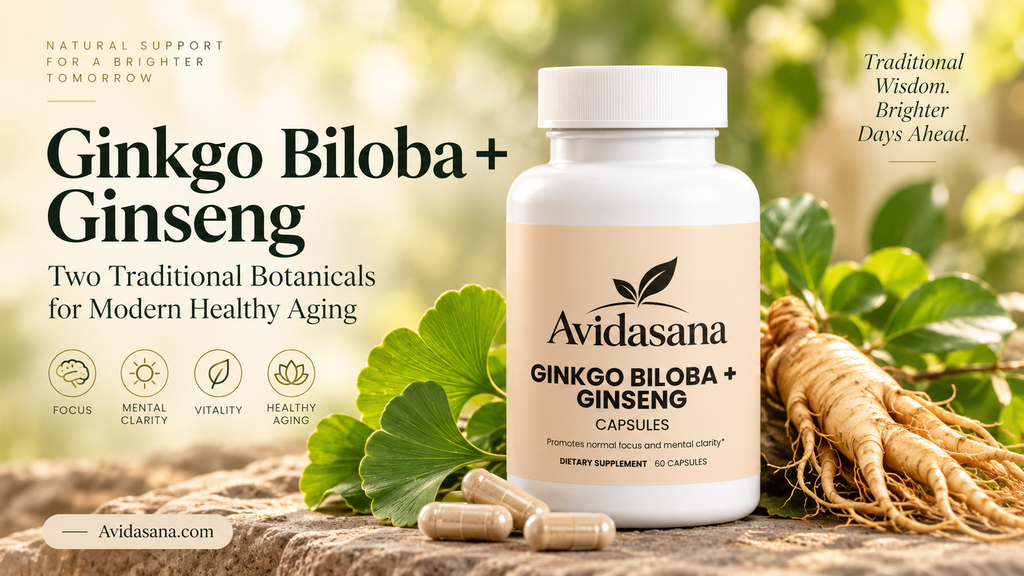
Avidasana brings them together in Ginkgo Biloba + Ginseng Capsules, a convenient formula designed to support normal focus and mental clarity as part of an overall healthy lifestyle.
But botanical supplements deserve something better than exaggerated promises. So let’s look at what these two plants are, why people use them, what the research actually says, and what older adults should know before adding them to a daily routine.
Two Plants With Very Long Histories
Ginkgo biloba is remarkable even before we talk about supplements.
The ginkgo tree is sometimes called a “living fossil” because its lineage stretches back millions of years. Ginkgo has a long history of use in traditional Chinese medicine, and today extracts from its leaves are widely sold as dietary supplements.
Ginseng has an equally impressive reputation.
Asian ginseng, or Panax ginseng, has traditionally been used in East Asian medicine and is often described as an adaptogenic botanical—a plant traditionally associated with helping the body cope with physical and mental demands. The compounds that receive the most scientific attention in ginseng are known as ginsenosides.
Put the two together, and you have a combination that has attracted considerable interest among people seeking support for focus, vitality, and everyday wellness.
Why Focus Becomes More Important With Age
Everybody forgets a name occasionally.
Everybody walks into a room and wonders why they went there.
And yes, sometimes the eyeglasses we are looking for are sitting on top of our head.
That is human.
Normal aging can bring changes in processing speed and attention, but cognitive health is much larger than any one supplement.
Regular physical activity, quality sleep, controlling blood pressure, staying socially connected, treating hearing loss, eating well, and continuing to challenge the brain are all important pieces of healthy aging.
A supplement should be viewed as one possible part of that larger picture, not as a replacement for it.
That distinction matters.
What Does Ginkgo Biloba Actually Do?
You have probably seen ginkgo advertised as a “memory supplement.”
That description needs some qualification.
Ginkgo has been studied extensively, but the National Center for Complementary and Integrative Health says there is no conclusive evidence that ginkgo prevents dementia or slows cognitive decline. A major study involving more than 3,000 older adults found that ginkgo did not reduce the risk of developing dementia.
That is important information, particularly for seniors.
A bottle of ginkgo should never be presented as protection against Alzheimer’s disease.
However, researchers continue to investigate ginkgo for various aspects of cognitive performance and other health applications. Some individual studies have suggested benefits in certain populations, but the overall evidence remains mixed.
In other words:
Interesting botanical? Yes. Miracle memory drug? No.
That is a much more responsible way to talk about it.
And What About Ginseng?
The research on Asian ginseng is also interesting without being definitive.
According to NCCIH, a small amount of research suggests that Asian ginseng may have beneficial effects on certain aspects of cognitive function, including attention and reaction time, particularly in middle-aged adults. Research into fatigue has also produced some promising findings, although the evidence is not consistent enough to make sweeping claims.
That is why ginseng has traditionally been associated with vitality, stamina, and mental energy.
Again, the key word is support.
Supplements do not turn back the biological clock.
But supporting the body while doing the things that actually matter—moving, eating well, sleeping, learning and staying socially connected—can be a reasonable part of a broader wellness strategy.
Why Combine Ginkgo and Ginseng?
This is where the formula becomes especially interesting.
Rather than approaching mental wellness from a single botanical, Avidasana Ginkgo Biloba + Ginseng combines two traditions in one formula.
Some research has specifically investigated the combination of ginkgo and ginseng. Small studies have reported changes in aspects of memory and cognitive performance, although these studies are not sufficient to establish that the combination treats or prevents cognitive disease.
The practical appeal is simpler.
Instead of taking separate supplements, someone interested in both botanicals can include them in one daily product.
Avidasana’s formula is positioned to promote normal focus and mental clarity as part of a healthy lifestyle.*
That is a sensible claim.
And frankly, sensible claims are preferable to the wild promises that have become far too common in the supplement world.
Healthy Aging Is About More Than Memory
When people hear “brain health,” they often immediately think about Alzheimer’s disease.
But everyday cognitive wellness is much broader.
It includes being able to:
follow a conversation,
read and understand something new,
make decisions,
organize your day,
remember appointments,
remain curious,
and participate actively in the world around you.
That last one may be the most important.
A healthy brain is not simply a brain that remembers yesterday.
It is a brain that is still interested in tomorrow.
The Best Supplement Still Needs a Healthy Lifestyle
There is a trap in the wellness business.
People understandably want something easy.
Take two capsules and everything improves.
Unfortunately, human biology does not work that way.
If your goal is healthy cognitive aging, the basics still carry enormous weight.
Exercise.
Sleep.
Good nutrition.
Hearing correction when needed.
Social interaction.
Blood-pressure management.
Learning.
Purpose.
And perhaps the most underrated ingredient of all:
curiosity.
A supplement belongs beside those habits—not instead of them.
That philosophy is especially important at Avidasana because our focus is not selling the fantasy of eternal youth.
It is helping people support their health as they age.
There is a difference.
A Word About Safety—Especially for Seniors
This is the section supplement advertisements often put in microscopic print.
We shouldn’t.
Older adults are more likely to take prescription medications, which means potential supplement-drug interactions become especially important.
Ginkgo may increase bleeding risk, particularly for people taking anticoagulant medications such as warfarin. It can also interact with other medications.
Asian ginseng can also interact with medications. Researchers have raised potential concerns involving some blood-pressure drugs, statins, antidepressants and medications affecting blood sugar or clotting. Insomnia is one of the more commonly reported side effects of ginseng.
So if you take prescription medications—particularly blood thinners, diabetes medications or cardiovascular drugs—talk with your doctor or pharmacist before using ginkgo, ginseng or a combination product.
That is not a disclaimer designed to frighten you.
It is simply smart supplement use.
Supplements Should Complement Medicine, Not Compete With It
There is sometimes an unnecessary argument between conventional medicine and supplements.
It does not need to be either/or.
Prescription medicine has a role.
Nutrition has a role.
Exercise has a role.
Supplements can have a role.
The intelligent approach is to use the right tool for the right purpose.
If you are experiencing new or worsening memory problems, confusion, difficulty managing everyday tasks, personality changes, or other concerning cognitive symptoms, buying a supplement should not be your first response.
Talk with your healthcare professional.
There may be medical issues that need to be evaluated.
What Makes Avidasana’s Approach Different?
At Avidasana, our philosophy is simple:
Healthy aging should be practical.
No fountain of youth.
No miracle pill.
No promise that a capsule will make you 30 again.
Quite frankly, who wants to go through being 30 again anyway?
The goal is not to erase age.
The goal is to support the body and mind you have today so that you can continue participating in your own life.
That means choosing supplements thoughtfully and understanding what they can—and cannot—do.
Avidasana Ginkgo Biloba + Ginseng combines two traditional botanicals in a convenient capsule designed for adults interested in supporting normal focus and mental clarity.*
You can learn more about the product at Avidasana.com.
The Larger Lesson: Keep Using Your Mind
Perhaps the most valuable message here has nothing to do with a capsule.
Your brain likes to be used.
Read.
Learn something unfamiliar.
Have conversations with people who disagree with you.
Take a class.
Dance.
Travel.
Write.
Play an instrument.
Learn how to use that new piece of technology—even if you occasionally want to throw it through the window.
Stay involved.
The objective of healthy aging is not simply to preserve ourselves.
It is to continue participating.
Ginkgo and ginseng may be useful additions to a thoughtful wellness routine.
But the most powerful ingredient in healthy elderhood may still be this:
Having something worth staying mentally sharp for.
Learn More
Explore Avidasana Ginkgo Biloba + Ginseng Capsules at Avidasana.com and discover other supplements designed with healthy aging in mind.
Avidasana — For Seniors, By a Senior.
These statements have not been evaluated by the Food and Drug Administration. This product is not intended to diagnose, treat, cure or prevent any disease. Consult your healthcare professional before beginning any dietary supplement, particularly if you take prescription medications.
