Skincare can become surprisingly complicated. One bottle promises radiance, another promises renewal, and before long your bathroom counter looks like it needs its own instruction manual.
Choosing your next product can be simpler: understand what it contains, what it is intended to do, and how your skin responds to it.
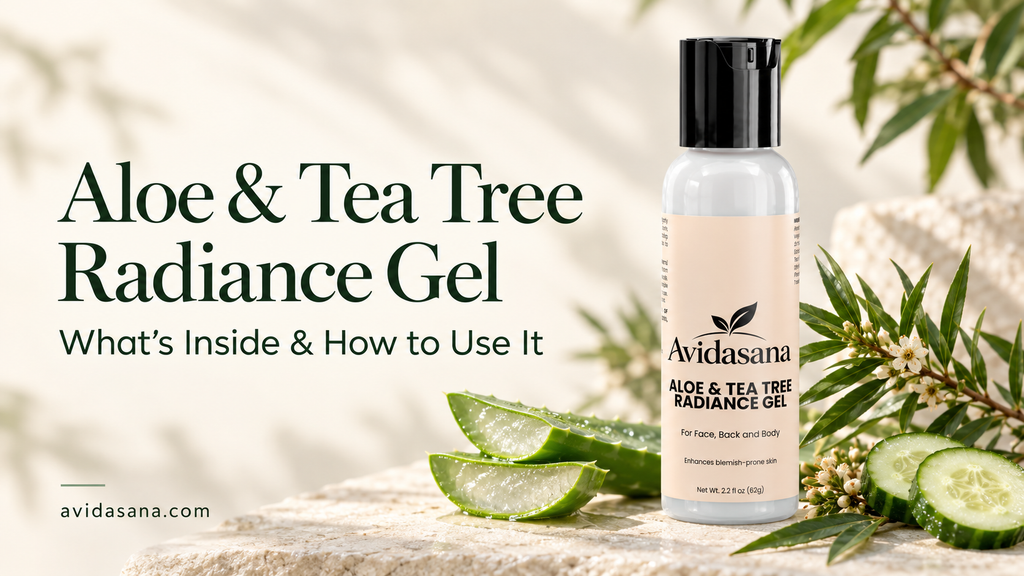
AvidaSana’s Aloe & Tea Tree Radiance Gel is presented as a cosmetic gel intended to improve the appearance of redness and blemishes while supporting a refreshed-looking complexion. Its formula brings together aloe vera, tea tree oil, cucumber extract, sweet almond oil, vegetable glycerine, and black willow bark oil.
If those ingredients interest you, here is how to look beyond the product name and decide whether it belongs in your routine.
Get to know the formula
The product description highlights aloe for moisture balance, cucumber for a refreshed feeling, and sweet almond oil for softness and hydration. Tea tree oil is included for its purifying role. The ingredient list also names thickeners and preservatives, which are part of the finished formula.
One detail deserves careful reading: the listed 2% refers to black willow bark oil. It does not identify the product as a 2% salicylic acid acne treatment.
Ingredient names are a useful starting point, but your experience depends on the complete formulation. Concentrations, other ingredients, and your own skin all matter. Recognizing a botanical name is not the same as knowing how a particular product will perform for you.
What aloe research can—and cannot—tell you
Aloe has a long history of topical use, and many people associate it with skin comfort. The National Center for Complementary and Integrative Health’s overview of aloe vera explains that topical aloe gel is generally well tolerated, although burning, itching, and rashes have occasionally been reported.
That is useful context when trying an aloe-containing product. It is also a reminder to judge your skin’s actual response rather than assuming a familiar plant ingredient will suit everyone.
Research involving aloe does not automatically establish the effectiveness of every formula that contains it. The AvidaSana product page does not provide a clinical trial of this finished gel. Reasonable expectations begin with that distinction.
For everyday shopping, ask yourself what you are hoping to change. Is it the way your skin feels after cleansing? The appearance of occasional blemishes? The number of products you use? A clear goal makes it easier to decide whether an addition is useful.
Tea tree oil: an ingredient worth understanding
Tea tree oil is widely associated with blemish-focused skincare. According to NCCIH’s review of tea tree oil, limited research suggests topical tea tree oil may help acne, but stronger evidence is needed before definite conclusions can be drawn.
Those findings concern studied preparations, not a guarantee about this gel. The product listing does not state the tea tree oil concentration, so it should not be assumed to match a research formula.
NCCIH also notes that topical tea tree products can cause redness or irritation in some people. Tea tree oil should never be swallowed.
The sensible approach is to treat tea tree as one ingredient in a cosmetic formula. Persistent acne or ongoing skin inflammation deserves an assessment rather than an endless rotation of products promising clearer skin.
Keep the rest of your routine manageable
A product does not need eleven companions to earn a place on your bathroom shelf.
The American Academy of Dermatology recommends a straightforward foundation of cleansing, moisturizing, and sun protection in its guide to building a skincare routine on a budget. It also explains that using many products can irritate skin as well as increase costs.
Think of an additional cosmetic gel as an optional step within that foundation. It does not replace sunscreen. For sun protection, the AAD recommends broad-spectrum sunscreen with SPF 30 or higher, alongside measures such as shade and protective clothing.
When you introduce something new, keep track of what you changed. If you replace your cleanser, add a serum, and try a gel on the same evening, it becomes difficult to tell which product your skin likes—or dislikes.
You do not need a spreadsheet. A brief note about when you started and what you noticed can be enough.
Test before applying widely
The AAD’s instructions for testing a new skincare product recommend applying it to a small test area twice daily for seven to ten days before wider use. Suggested locations include the underside of the arm or the elbow bend.
Use the amount and thickness you would normally apply, and observe for redness, itching, or swelling. If a reaction develops, wash the product off and stop using it. Seek medical help for a severe reaction.
This home test can help identify a poorly tolerated product; it is different from diagnostic allergy testing by a clinician and cannot guarantee you will never react.
Check ingredients against any known allergies, too. Since this formula lists sweet almond oil, someone with an almond allergy should ask their allergist about suitability rather than relying on a general marketing badge.
Follow the product’s directions
The gel’s suggested-use instructions describe applying it to blemished areas after cleansing and lightly drying the skin. Follow the current package label for application details. The online directions do not specify a daily frequency.
The product is for external use. Keep it away from the eyes and open wounds, and discontinue it if irritation occurs.
If you already use prescription skincare, ask your prescriber how an additional product would fit. There is no benefit in guessing about a combination when a straightforward question could clarify it.
Choose skincare that earns its place
Good product shopping starts with curiosity and ends with a practical decision. Do you understand the ingredients? Does the intended use match your goal? Can you introduce it without making your routine unnecessarily complicated?
You can explore AvidaSana’s aloe gel collection and review the full product listing before deciding.
Give yourself permission to keep what works, leave out what does not, and resist the idea that more bottles automatically mean better care. Your routine should be something you can understand and maintain comfortably.
Explore Aloe & Tea Tree Radiance Gel for the complete ingredient list, current availability, and product directions.
