There comes a point in life when dinner can become a negotiation.
You eat the same meal you enjoyed for years, but now your stomach seems to have developed opinions.
A little bloating here. A little gas there. Maybe a feeling of fullness that lingers much longer than it used to.
That does not automatically mean something is wrong. But it does raise an important question:
What exactly helps your body break food down — and can digestive enzymes play a useful role?
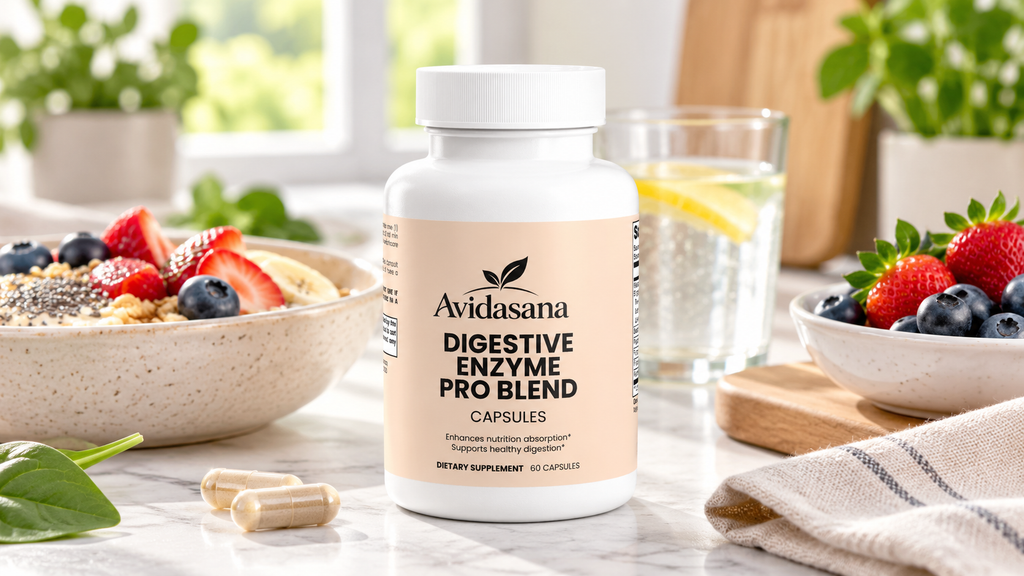
At AvidaSana, we believe supplements should be understood before they are purchased. So let’s look at what digestive enzymes actually do, why digestion can sometimes feel more difficult with age, and where a product such as Digestive Enzyme Pro Blend may fit into a sensible wellness routine.
Explore AvidaSana Digestive Enzyme Pro Blend
What Are Digestive Enzymes?
Digestive enzymes are proteins your body naturally produces to help break food into smaller components that can be absorbed and used.
Digestion starts before food ever reaches your stomach.
Saliva begins breaking down food in your mouth. Your stomach continues the process. Your pancreas and small intestine then release additional enzymes that help digest carbohydrates, fats and proteins.
The major enzymes include:
- Amylase, which helps break down carbohydrates and starches
- Protease, which helps break down proteins
- Lipase, which helps digest fats
- Lactase, which helps break down lactose found in dairy foods
Your pancreas is especially important because it produces several of the major digestive enzymes used during digestion.
Think of enzymes as tiny kitchen assistants.
You eat the steak, potatoes and salad.
The enzymes get busy chopping everything into pieces small enough for your digestive system to work with.
No apron required.
Why Digestion Can Become More Noticeable With Age
Many adults notice that digestion feels different as they get older.
Meals that once caused no problem may suddenly leave them feeling overly full, uncomfortable or bloated.
That does not necessarily mean the body has simply “stopped making enzymes.” In fact, healthy people generally continue producing the digestive enzymes they need. Johns Hopkins specifically notes that most healthy people do not require digestive enzyme supplements.
But several things can affect digestion as we age.
Medications may change.
Eating patterns may change.
Physical activity may decline.
We may eat larger meals less frequently.
Certain health conditions can also affect the stomach, intestines or pancreas.
And conditions such as lactose intolerance or pancreatic enzyme insufficiency can interfere with the body’s ability to break down particular foods.
So the question should not be:
“I’m older, therefore I need digestive enzymes.”
The smarter question is:
“What is causing my digestive discomfort, and would enzyme support make sense for me?”
That distinction matters.
What Does Digestive Enzyme Pro Blend Do?
A multi-enzyme supplement such as AvidaSana’s Digestive Enzyme Pro Blend is designed to provide additional digestive-enzyme support around meals.
The basic idea is straightforward.
Different foods require different enzymes.
Protein needs protease.
Fat needs lipase.
Carbohydrates need enzymes such as amylase.
Dairy may require lactase.
That is why multi-enzyme formulas are generally designed to support the digestion of several food groups rather than focusing on only one.
Digestive enzymes themselves are biologically important because they help convert food into smaller molecules the body can absorb.
That does not mean an over-the-counter enzyme supplement will fix every digestive complaint.
Far from it.
But for someone looking for nutritional support around meals, a broad enzyme blend can be a reasonable product to discuss with a healthcare professional.
Digestive Enzymes Are Not the Same as Probiotics
This distinction causes a lot of confusion.
Digestive enzymes and probiotics both relate to digestion, but they do completely different jobs.
Digestive enzymes help break food down.
Probiotics are living microorganisms that contribute to the community of bacteria in the digestive tract.
Johns Hopkins describes probiotics as supporting digestive health, while enzymes are directly involved in breaking down components of food.
A simple way to remember it:
Enzymes help process the meal. Probiotics help support the neighborhood.
Some digestive-support formulas contain both, but they should not be thought of as interchangeable.
If you are exploring broader nutritional support, you can also browse the AvidaSana supplement shop to compare products by health goal.
Could Digestive Enzymes Help With Bloating?
Possibly — depending on what is causing the bloating.
That last part is critical.
If you have difficulty digesting lactose, for example, lactase may help break down milk sugar.
Alpha-galactosidase can help digest certain complex carbohydrates that are commonly associated with gas.
But bloating can have many causes.
Eating too quickly.
Constipation.
Large meals.
Carbonated drinks.
Food intolerances.
Irritable bowel syndrome.
Medication side effects.
And numerous medical conditions.
That is why persistent bloating should not automatically be treated with supplements.
Johns Hopkins recommends medical evaluation when symptoms such as bloating, diarrhea, pain, oily stools or unexplained weight loss persist.
A supplement can support digestion.
It should not become a substitute for figuring out why something hurts.
What About Nutrient Absorption?
This is one of the most important jobs of digestion.
You do not benefit simply because nutrients entered your mouth.
Food must be broken down into forms your body can absorb.
Proteins become amino acids.
Fats become fatty acids.
Carbohydrates are broken down into smaller sugars.
Digestive enzymes participate throughout this process.
This is why medically diagnosed enzyme deficiencies can become serious.
People with true pancreatic enzyme insufficiency can struggle to absorb nutrients properly and may require prescription pancreatic enzyme replacement therapy.
That is a medical treatment — not the same thing as an over-the-counter digestive supplement. Johns Hopkins notes that prescription pancreatic enzyme replacement therapy is used for diagnosed conditions in which the pancreas does not produce enough digestive enzymes.
That distinction is worth emphasizing.
Supplement support and medical enzyme replacement are not the same thing.
Should Everyone Take Digestive Enzymes?
No.
And any supplement company telling you otherwise should make you suspicious.
Healthy people generally produce the enzymes necessary to digest food.
Cleveland Clinic notes that most people do not need to worry about making enough digestive enzymes unless they have a deficiency or specific medical issue.
This is exactly why the AvidaSana philosophy should be:
Use supplements for a reason, not because somebody on social media made a dramatic video.
A supplement makes more sense when there is a clear goal.
Maybe your doctor or dietitian suggested enzyme support.
Maybe certain meals consistently cause digestive discomfort.
Maybe you have already worked on portion size, food choices and eating habits but still want additional digestive support.
That is a more thoughtful approach than simply collecting bottles.
How to Make Digestion Easier Without Buying Anything
Supplements get attention because they come in bottles.
But some of the most useful digestive strategies do not.
Start with the basics.
Eat more slowly.
Chew thoroughly.
Avoid enormous meals.
Pay attention to which foods repeatedly cause symptoms.
Stay hydrated.
Include appropriate amounts of fiber.
Remain physically active.
And avoid assuming that every digestive problem requires another capsule.
A balanced diet containing fruits, vegetables, whole grains and quality protein supports the normal digestive process. Johns Hopkins emphasizes that a whole-food diet is generally more important than chasing so-called “enzyme-rich” foods or supplements for otherwise healthy people.
This is also consistent with the broader AvidaSana approach to healthy aging.
Supplements are supposed to supplement a healthy lifestyle.
The clue was hiding in the name all along.
When You Should Talk to Your Doctor
Digestive complaints deserve more attention when they are persistent, severe or changing.
Talk with your healthcare provider if you experience:
- ongoing abdominal pain
- persistent diarrhea
- frequent vomiting
- unexplained weight loss
- oily or unusually pale stools
- blood in the stool
- difficulty swallowing
- sudden major changes in bowel habits
- symptoms that repeatedly wake you at night
Those problems should not be treated by simply adding digestive enzymes and hoping for the best.
They may signal something that needs medical evaluation.
And if you take prescription medications, it is also smart to ask your doctor or pharmacist before adding any new supplement.
AvidaSana’s own broader philosophy emphasizes transparency and reviewing supplement choices with a healthcare professional when necessary.
What Should You Look for in a Digestive-Enzyme Supplement?
The label matters.
Look for a product that clearly identifies what it contains.
Avoid mystery blends that make enormous promises but provide little useful information.
You should be able to determine:
- serving size
- enzyme types
- other ingredients
- suggested use
- manufacturer information
- safety warnings
- number of capsules or servings
You should also ignore claims that sound too good to be true.
Digestive enzymes do not “detox” your body.
They do not melt belly fat.
They do not reverse aging.
They do not compensate for a consistently poor diet.
Their biological job is much less glamorous.
They help break food down.
And sometimes boring biology is exactly what we want.
A Sensible Place for Digestive Enzyme Pro Blend
AvidaSana’s Digestive Enzyme Pro Blend can be viewed as part of a broader digestive-wellness strategy rather than as a cure for digestive disease.
For adults who are looking for additional digestive support around meals, a multi-enzyme formula may be worth considering.
The important word is support.
Not treatment.
Not cure.
Not miracle.
That is the language responsible supplement companies should use.
You can learn more about Digestive Enzyme Pro Blend at AvidaSana and compare it with other nutritional products in the AvidaSana Shop.
For readers interested in maintaining physical strength and healthy aging more broadly, AvidaSana also offers Brain & Body Creatine, another product designed around supporting normal body function rather than promising instant transformation.
The Bigger Lesson: Pay Attention to Your Body
One of the advantages of getting older is that eventually you learn your body has been sending messages all along.
Sometimes politely.
Sometimes with all the subtlety of a fire alarm.
Digestive discomfort is information.
It may mean you ate too much.
Too fast.
Too late.
It may mean a particular food no longer agrees with you.
It may mean your digestive system could use additional support.
And occasionally, it may mean something needs to be evaluated by a medical professional.
The goal is not to silence every symptom with another supplement.
The goal is to understand what your body is telling you.
The Bottom Line
Digestive enzymes play an essential role in breaking down proteins, fats and carbohydrates so nutrients can be absorbed and used by the body. Your body naturally produces these enzymes, and most healthy people make enough on their own.
But digestive needs vary from person to person.
For some adults, a digestive enzyme supplement may offer additional support around meals. For others, changing eating habits may be all that is needed. And when symptoms persist, the right answer may be medical evaluation rather than supplementation.
That is the balanced way to look at Digestive Enzyme Pro Blend.
Not as a miracle.
Not as a replacement for healthy eating.
But as one possible tool in a larger healthy-aging toolbox.
At AvidaSana, that is the idea:
Understand what you are taking. Know why you are taking it. And use supplements to support the life you are already working to keep healthy.
AvidaSana — For Seniors, By a Senior.
