For years, creatine had an image problem.
Mention the word “creatine,” and most people pictured a 25-year-old bodybuilder standing in a gym next to a bucket of protein powder large enough to feed a small village.
But the science of creatine has moved far beyond bodybuilding.
Today, researchers are looking at creatine in a much broader way — particularly its potential role in maintaining muscle strength, physical function, cellular energy, and possibly some aspects of cognitive health as we grow older.
And that last part is important.
Because after 60, strength is no longer primarily about building bigger muscles.
Strength is about getting out of a chair.
Carrying groceries.
Climbing stairs.
Keeping your balance.
Walking confidently.
Traveling.
Dancing.
Living independently.
And brain function is not about winning a memory contest.
It is about remaining engaged, alert, capable, curious, and independent.
That is why creatine deserves a second look.
What Exactly Is Creatine?
Creatine is not a stimulant.
It is not a steroid.
And it is certainly not some mysterious laboratory chemical invented for bodybuilders.
Creatine is a naturally occurring compound found in the human body. It is involved in the system cells use to rapidly regenerate energy.
Your muscles contain most of the body’s creatine, although creatine is also present in other tissues, including the brain.
We obtain some creatine through foods, particularly meat and fish, and our bodies also produce it.
The important connection is energy.
Your cells use a molecule called ATP — adenosine triphosphate — as a primary source of usable cellular energy.
Creatine helps the body rapidly replenish ATP during periods of increased energy demand.
That is one reason creatine has been studied so extensively for physical performance.
But muscles are not the only tissues requiring energy.
Your brain is an extremely energy-demanding organ as well.
And that has led researchers to investigate whether creatine supplementation might have benefits beyond the gym.
Why Creatine Becomes More Interesting After 60
Aging changes the body.
Muscle mass and strength tend to decline.
Recovery can take longer.
Activity levels sometimes decrease.
And maintaining enough muscle becomes increasingly important for mobility and independence.
This gradual age-related loss of muscle mass and function is often discussed under the term sarcopenia.
Research examining older adults has found particularly encouraging results when creatine supplementation is combined with resistance exercise.
A recent systematic review and meta-analysis found that adding creatine to resistance training in older adults produced improvements in lean tissue mass and lower-body strength compared with resistance training alone.
Earlier research has reached similar conclusions, with creatine combined with resistance exercise showing benefits for lean tissue and measures of muscular strength.
That does not mean taking creatine replaces exercise.
Quite the opposite.
The evidence gives us another reason to think about creatine and exercise as partners rather than competitors.
At AvidaSana, we have written more about this larger issue in Why Your Body Feels Weaker After 60 — And What You Can Do About It. Read the AvidaSana article on muscle loss after 60
The goal is not bodybuilding.
The goal is maintaining enough strength to continue living your life.
Muscle Is an Independence Organ
We usually think of muscle as something cosmetic.
That is a young person’s way of looking at it.
After 60, muscle should be viewed differently.
Muscle helps you:
- Rise from a chair
- Recover your balance
- Carry groceries
- Climb stairs
- Get up from the floor
- Walk farther
- Maintain mobility
- Continue doing the activities you enjoy
In other words, muscle is part of your independence.
That is why maintaining strength becomes more important with age rather than less important.
Resistance exercise remains one of the most valuable tools available.
You do not have to become a gym fanatic.
Weights, resistance bands, bodyweight exercises, machines, and appropriately designed strength programs can all help.
Creatine should be considered support for that foundation — not a replacement for it.
But What About the Brain?
This is where things become especially interesting — and where we need to be careful not to get ahead of the research.
The brain uses substantial amounts of energy.
Because creatine participates in cellular energy metabolism, scientists have investigated whether increasing creatine availability could influence cognitive performance.
A 2025 systematic review specifically examining creatine and cognition in adults over 55 found that five of six included studies reported a positive association in areas such as memory and attention.
But there was an important qualification.
The researchers described the evidence as limited and called for better-quality clinical trials before stronger conclusions could be drawn.
Another systematic review published in 2024 was more cautious, concluding that cognitive results remained mixed despite evidence that supplementation can increase creatine concentrations in the brain.
That distinction matters.
We should not turn “promising research” into “proven miracle.”
The Internet already has enough miracle supplements.
What we can reasonably say is that creatine has a well-established biological role in energy metabolism, substantial research behind its muscular benefits, and a developing — but not yet definitive — body of research examining brain and cognitive effects.
That is interesting enough without exaggerating it.
Your Muscles and Brain Are Not Separate Islands
One of the more interesting developments in healthy-aging research is recognition of the relationship between physical health and cognitive health.
Exercise does not simply change muscles.
Movement affects blood flow, metabolism, sleep, mood, cardiovascular health, insulin sensitivity, and many other systems that matter to the brain.
A recent review looking at creatine and exercise in aging described this relationship as part of a muscle-brain axis, with the combination potentially supporting both physical and cognitive health.
That fits a larger principle we believe strongly at AvidaSana:
The body works as a system.
Better sleep can improve energy.
Better strength can improve mobility.
Better mobility can increase social activity.
More activity can support cardiovascular and metabolic health.
Better metabolic health can support brain health.
Healthy aging rarely comes from fixing one isolated part.
It comes from supporting the entire system.
No Supplement Can Outrun a Bad Lifestyle
This may be the most important part of this article.
Creatine is not a substitute for movement.
It is not a substitute for protein.
It is not a substitute for sleep.
It is not a substitute for controlling blood pressure.
It is not a substitute for maintaining healthy blood sugar.
And it is definitely not permission to spend fourteen hours a day in a recliner because you took a scoop of powder at breakfast.
Supplements should supplement.
The word itself tells us their job.
Your foundation remains remarkably unglamorous:
Move.
Use your muscles.
Eat nutritious food.
Sleep.
Stay hydrated.
Manage your medical conditions.
Maintain social connection.
Keep learning.
Then consider whether carefully selected supplements can support those fundamentals.
That is also the philosophy behind our article Healthy Aging Starts With the Small Choices You Make Every Day. Read Healthy Aging Starts With the Small Choices You Make Every Day
There is no magic switch.
There are simply better choices repeated often enough to matter.
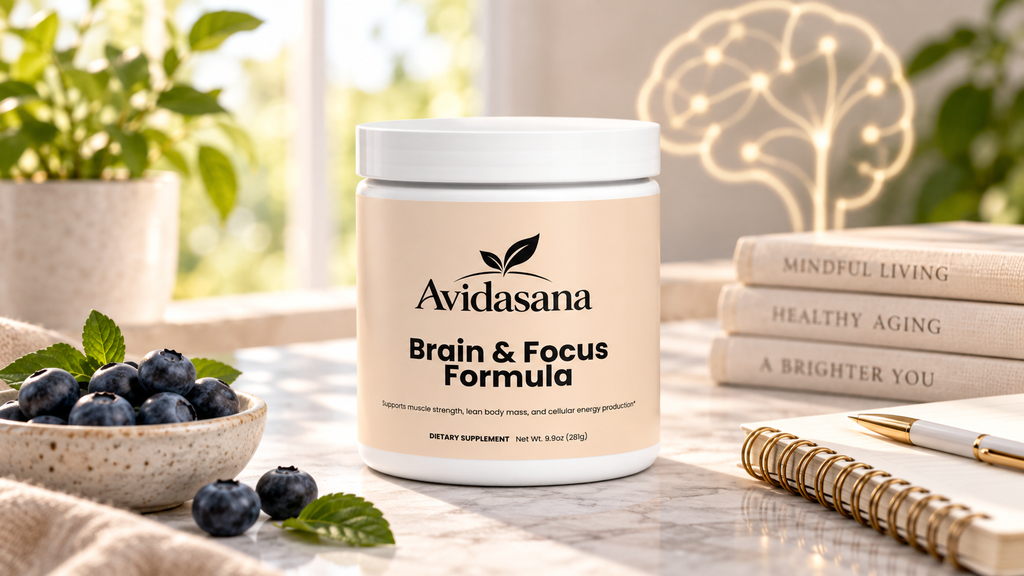
Why We Created Brain & Body Creatine
AvidaSana’s Brain & Body Creatine was created around a simple idea:
Creatine should not be marketed only to athletes.
Older adults care about performance too.
Our performance goals are simply different.
We want enough strength to move confidently.
Enough energy to stay active.
Enough physical capacity to participate in life.
And we want to support the biological systems involved in maintaining healthy brain function as we age.
The AvidaSana formula uses creatine monohydrate, the form used in the great majority of creatine research. The current product is unflavored and manufactured in the United States.
You can see the complete product information and usage instructions on the Brain & Body Creatine product page. View AvidaSana Brain & Body Creatine
And if you are comparing different products for mental energy and focus, we have also explained some of the evidence behind several commonly discussed nutrients and compounds in What Health Supplements Actually Work for Energy and Focus? Read our guide to supplements for energy and focus
A Word About Expectations
Creatine is one of the most researched dietary supplements available.
That does not make it magic.
You are probably not going to take creatine Monday morning and suddenly remember where you left the car keys in 1997.
And if someone promises that, keep one hand on your wallet.
The strongest healthy-aging evidence is associated with muscle, strength, and physical function — particularly when creatine is paired with resistance training.
Research into cognition is encouraging enough to deserve attention, but not strong enough to claim that creatine prevents dementia, Alzheimer’s disease, or cognitive decline.
We do not make those claims.
There is a tremendous difference between supporting normal biological function and treating disease.
That distinction matters.
Is Creatine Right for Everyone?
No supplement is automatically appropriate for every person.
If you take prescription medications, have kidney disease or another medical condition, or have been told by your physician to restrict certain supplements or nutrients, discuss creatine with your healthcare professional before starting it.
And show them the label.
One of the principles behind AvidaSana is transparency.
Your doctor or pharmacist should be able to see what you are taking.
Supplements should not become secret experiments we perform on ourselves.
You can learn more about AvidaSana’s approach to supplement transparency and healthy aging on our About AvidaSana page. Learn about the AvidaSana philosophy
The Bigger Picture: Staying Capable
Ultimately, creatine is not really the story.
Capability is the story.
Can you continue walking?
Can you keep exercising?
Can you lift what needs lifting?
Can you get out and see people?
Can you travel?
Can you think clearly enough to manage your life?
Can you continue doing the things that make your life yours?
Those are the outcomes that matter after 60.
Healthy aging is not about trying to become 25 again.
We already did 25.
Once was enough.
The goal now is to protect what allows us to remain independent, interested, engaged, mobile, and alive to the world.
Creatine may be one useful tool in that larger toolbox.
Not magic.
Not a cure.
Not the fountain of youth.
Just an extensively studied compound with particularly strong evidence around muscle and physical performance and intriguing emerging research around brain energy and cognition.
And sometimes healthy aging does not require discovering something revolutionary.
Sometimes it requires taking something we thought we understood — and looking at it through older, wiser eyes.
AvidaSana — Ancient Wisdom. Modern Wellness.
Dietary supplements are not intended to diagnose, treat, cure, or prevent disease. Speak with your physician or pharmacist about supplements if you have a medical condition or take prescription medications.
