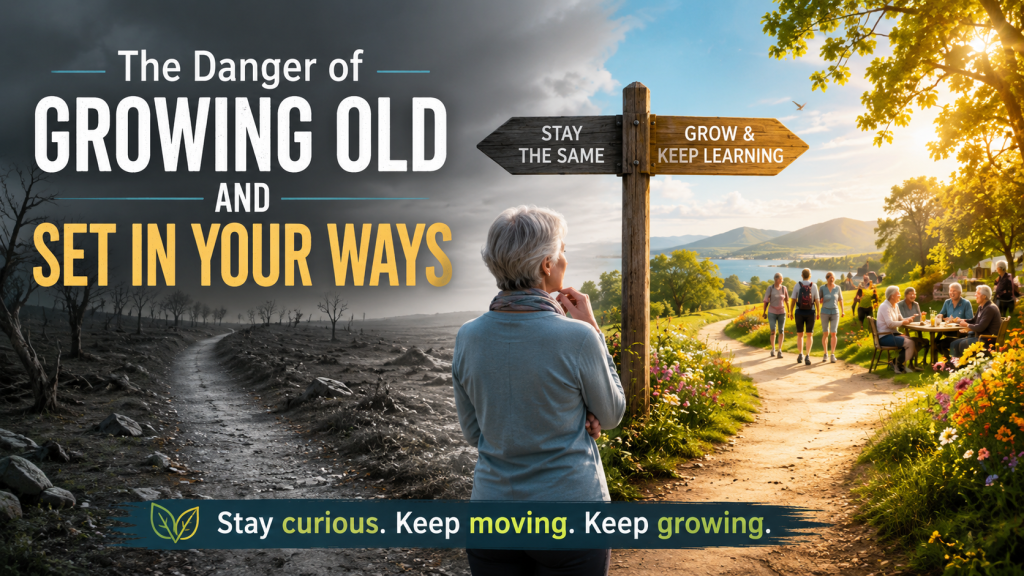
There is a big difference between growing older and becoming old in your thinking.
Growing older is biology. It happens to all of us fortunate enough to keep having birthdays.
Becoming rigid, however, is something else entirely.
It happens when we stop questioning what we believe, stop trying new things, stop learning, stop moving, and gradually decide that the way we have always done things is the way they must always be done.
That may feel comfortable.
It can also quietly make life smaller.
At A Vida Sana, healthy aging is not simply about adding years to life. It is about protecting the health, independence, curiosity, and energy that allow us to continue participating in those years.
And one of the most overlooked parts of healthy aging may be this:
Stay adaptable.
“I’ve Always Done It This Way”
Few sentences reveal a closed door more clearly than:
“I’ve always done it this way.”
Sometimes experience gives us a very good reason to continue doing something the same way.
But experience can also become a trap.
Imagine using the same telephone you owned in 1985 simply because it worked perfectly well then.
Or refusing to use GPS because you have always carried a road map.
There is nothing wrong with a road map.
The problem occurs when loyalty to the familiar prevents us from benefiting from something better.
The same principle applies to our health.
Ideas about nutrition have changed.
Ideas about exercise have changed.
Our understanding of sleep has changed.
Medical treatments have changed.
Technology has changed.
The scientific understanding of aging itself continues to change.
Someone who decided 30 years ago that they already knew everything they needed to know about health would have missed an extraordinary amount of progress.
Healthy Aging Requires Adaptation
Healthy aging is sometimes presented as if there were a secret formula.
Take this supplement.
Eat this food.
Avoid that food.
Do this exercise.
But human health is rarely that simple.
The National Institute on Aging points to a combination of factors associated with healthy aging, including physical activity, nutritious eating, maintaining social connections, getting appropriate health care, and remaining mentally active.
Notice something interesting about that list.
None of those behaviors works particularly well if we become completely set in our ways.
Healthy eating requires occasionally learning something new.
Exercise requires adjusting as our bodies change.
Social connection requires meeting people and maintaining relationships.
Mental activity requires curiosity.
Managing our health requires listening when better information becomes available.
In other words, healthy aging itself demands adaptation.
Your Body Changes, So Your Strategy May Need to Change
The exercise routine that worked beautifully at 40 may not be the ideal exercise routine at 75.
That doesn’t mean you stop exercising.
It means you adapt.
Maybe running becomes walking.
Maybe heavy weights become resistance bands.
Maybe tennis becomes swimming.
Maybe you add balance exercises that weren’t important to you 30 years ago.
The goal remains the same:
Keep moving.
The strategy changes.
Current CDC guidance recommends that adults 65 and older aim for a combination of aerobic activity, muscle-strengthening activity, and balance work. The general target is at least 150 minutes of moderate-intensity aerobic activity per week, along with muscle strengthening on at least two days.
But this is where being flexible matters.
Someone may say:
“I hate gyms.”
Fine.
You don’t need a gym to move your body.
Walk.
Garden.
Dance.
Ride a bicycle.
Use resistance bands.
Take a water exercise class.
Do exercises at home.
The healthiest activity is often the one you will actually continue doing.
At A Vida Sana, we believe health should fit into life—not make life feel like punishment.
Movement Is More Than Exercise
Another dangerous habit is assuming physical activity only counts when you are “working out.”
It doesn’t.
Movement matters throughout the day.
Walking through a store counts.
Taking stairs counts.
Gardening counts.
Carrying groceries counts.
Dancing counts.
Playing with grandchildren counts.
The CDC emphasizes that some physical activity is better than none and that activity can be spread throughout the week in smaller chunks.
That is encouraging because healthy aging does not require becoming an athlete.
It requires refusing to become unnecessarily sedentary.
The couch is comfortable.
Very comfortable.
Possibly too comfortable.
There comes a point when our favorite chair starts acting less like furniture and more like an accomplice.
The Brain Needs New Experiences Too
Our muscles are not the only part of us that responds to challenge.
Our brains do too.
The brain has an ability known as neuroplasticity—the capacity to adapt and reorganize in response to experience and learning. Researchers continue studying these mechanisms throughout the lifespan.
That does not mean doing crossword puzzles guarantees you will never experience cognitive decline.
It means the older brain is not simply a machine that stops changing.
Learning still matters.
New experiences still matter.
Mental challenge still matters.
The National Institute on Aging has reported research suggesting that sustained involvement in new, cognitively demanding activities may support memory in older adults.
So learn something.
It does not have to be academic.
Learn how to use a smartphone feature.
Learn another language.
Learn to cook something unfamiliar.
Take dance lessons.
Learn photography.
Study history.
Read philosophy.
Figure out artificial intelligence.
Try something that forces your brain to say:
“Hold on. I haven’t done this before.”
That little moment of difficulty may be exactly the point.
Curiosity Is a Healthy Habit
There is a wonderful question that becomes more valuable as we get older:
“What if I’m wrong?”
Not about everything.
And certainly not because every new idea is better than an old one.
Plenty of new ideas are nonsense.
But intellectual curiosity gives us permission to examine new information without immediately accepting or rejecting it.
Consider how dramatically nutrition advice has changed during the average senior’s lifetime.
Eggs were bad.
Then maybe they weren’t so bad.
Fat was the enemy.
Then researchers began separating different types of fat.
Coffee was suspicious.
Now moderate coffee drinking has been studied for potential associations with several health outcomes.
The details keep evolving because science keeps learning.
The wise response isn’t to believe every headline.
It is also not to say:
“They keep changing their minds, so I’m ignoring all of it.”
A better response is:
“What does the best evidence say now?”
That is not inconsistency.
That is adaptability.
Don’t Confuse Wisdom With Stubbornness
There is tremendous value in getting older.
Experience matters.
At 70 or 80, you have seen things that a 25-year-old simply has not had time to see.
You have watched trends come and go.
You have probably survived crises that once seemed impossible.
You know people.
You know yourself.
You have learned that many problems eventually pass.
That is wisdom.
But wisdom can quietly become stubbornness when we decide that experience has taught us everything there is to know.
Wisdom says:
“I have learned something from the past.”
Stubbornness says:
“Nothing new can teach me anything.”
Those are not the same thing.
The wisest person in the room may be the person most willing to say:
“I hadn’t thought of it that way.”
Social Isolation Can Begin With Saying No
Becoming set in our ways can affect more than our minds and bodies.
It can affect our relationships.
Imagine how easily these sentences can accumulate:
“I don’t go out at night anymore.”
“I don’t like crowds.”
“I don’t want to meet new people.”
“I don’t like those restaurants.”
“I don’t understand what younger people talk about.”
“I don’t want to use video calls.”
“I don’t want to join a club.”
Again, every individual decision may be reasonable.
But eventually ten small “no’s” can build a wall.
And on the other side of that wall is loneliness.
Social engagement matters in healthy aging. The National Institute on Aging notes that research involving thousands of adults 65 and older found an association between greater social engagement and better cognitive health later in life.
That does not mean you need a packed social calendar.
It means relationships deserve maintenance just like muscles do.
Call someone.
Join something.
Volunteer.
Have coffee with a friend.
Take a class.
Say yes occasionally when your first instinct is no.
Sometimes the best thing for your health may be leaving the house.
Healthy Aging Is Not About Pretending You’re Young
There is an important distinction here.
Staying adaptable does not mean pretending to be 25.
It does not mean dressing like your grandchildren, using every new app, or ignoring legitimate physical limitations.
Healthy aging is not denial.
It is adaptation.
You recognize reality.
Then you work with it.
Perhaps your balance isn’t what it once was.
Work on balance.
Maybe your hearing has changed.
Address your hearing.
Maybe you need more recovery after exercise.
Recover.
Maybe medication changes the way you need to eat or exercise.
Adapt.
There is no prize for pretending nothing has changed.
The goal is to respond intelligently to the changes that have occurred.
Nutrition Is Another Place Where We Can Get Stuck
Food may be one of the strongest habits we carry through life.
Many of us eat the way we learned to eat decades ago.
Some of those habits are excellent.
Others deserve another look.
Healthy eating does not require chasing every diet trend that appears on the internet.
But it may mean asking whether your current eating habits support your current health goals.
Are you getting enough protein?
Enough fiber?
Enough fruits and vegetables?
Are highly processed foods crowding out more nutritious choices?
Are you drinking enough water?
Has your appetite changed?
Have your medications changed?
Nutrition is not frozen in time.
Our needs can change as we age.
That is why A Vida Sana focuses on practical healthy-living choices rather than miracle promises.
Supplements may have a role for some people, but they do not replace the foundations of good health: nutritious food, movement, sleep, social connection, and appropriate medical care.
The Danger of Automatically Rejecting Technology
Technology deserves special attention because it is one of the easiest things for older adults to reject.
And understandably so.
Passwords.
Updates.
Verification codes.
Apps.
Notifications.
Devices that somehow update themselves overnight and move every button you finally learned how to use.
Technology can be maddening.
But technology also offers remarkable tools for healthy aging.
Telehealth.
Medication reminders.
Fitness tracking.
Hearing technology.
Video conversations with family.
Online education.
Artificial intelligence.
Digital medical records.
Navigation.
Emergency alerts.
You do not need to embrace everything.
But rejecting all of it because you dislike some of it may eventually work against your independence.
Technology should be a tool.
You remain the person holding the tool.
Give Yourself Permission to Reinvent Yourself
One of the great opportunities of getting older is that you may finally have the freedom to ask:
“What do I actually want to do now?”
For decades, life may have been structured around work, raising children, mortgages, schedules, and responsibilities.
Then something changes.
Retirement arrives.
The children are grown.
Suddenly there is time.
Some people respond by trying to preserve their old life.
But perhaps the better question is:
What can I build next?
Write.
Travel.
Volunteer.
Exercise.
Garden.
Teach.
Start a small business.
Learn.
Create.
Mentor someone.
Take up music.
Dance badly.
Then dance slightly less badly next year.
The senior years do not have to be an epilogue.
They can be another chapter.
Try the One-New-Thing Rule
Here is a simple A Vida Sana challenge:
Regularly do one thing that is new to you.
Not dangerous.
Not foolish.
Just unfamiliar.
Try a new vegetable.
Walk a new route.
Listen to different music.
Talk to someone you normally wouldn’t.
Try a new exercise.
Learn a new piece of technology.
Read a book outside your usual interests.
Change one habit you’ve followed for decades and see what happens.
The goal is not novelty for novelty’s sake.
The goal is to prevent your life from becoming completely automatic.
Keep the Roots. Move the Branches.
There is no need to abandon everything you believe simply because the world changes.
Keep your principles.
Keep your values.
Keep the relationships that matter.
Keep the lessons you earned through experience.
But stay flexible enough to respond when better information arrives.
Think of a healthy tree.
Its roots are strong.
But its branches move with the wind.
A completely rigid tree eventually breaks.
Human beings can be much the same.
The Bottom Line
The danger of growing older is not simply the number of candles on the birthday cake.
It is allowing our world to become smaller because we stop participating in change.
Healthy aging requires more than caring for the body.
It requires maintaining curiosity.
Movement.
Relationships.
Purpose.
And a willingness to keep learning.
The goal isn’t to chase youth.
The goal is to remain engaged with life.
At A Vida Sana, that is what healthy living really means.
Make better choices.
Keep moving.
Keep learning.
Stay curious.
Be willing to change your mind when better evidence arrives.
And every once in a while, do something that makes you slightly uncomfortable simply because you’ve never done it before.
Because life does not stop changing when we reach 60, 70, 80, or beyond.
Neither should we.
Grow older if you must.
Just don’t become finished.
This article is for general educational purposes and is not a substitute for individualized medical advice. Talk with your healthcare professional before making significant changes to exercise, diet, medications, or supplement use.
