Memory is one of the biggest fears people have as they get older.
You walk into a room and forget why you went there. You misplace your glasses, then find them on your head. You forget a name, then remember it three hours later while brushing your teeth. That kind of thing can make anyone wonder, “Is this normal aging, or is something going wrong?”
So it is no surprise that brain health supplements are everywhere.
Walk into a pharmacy or search online and you will see pills, powders, gummies, drinks, and “memory formulas” promising sharper thinking, better focus, and stronger recall. Some make it sound like one capsule can turn your brain into a filing cabinet with Wi-Fi.
Let’s slow down.
Some nutrients are important for brain health. Some supplements may help if you are deficient. But many “brain booster” products are overpromised, overpriced, and under-proven. The goal is not to chase miracles. The goal is to understand what may actually support the brain, what is worth discussing with your doctor, and what deserves a raised eyebrow.
First, the Brain Needs Basics Before Bottles
Before talking about supplements, we need to say the obvious thing that supplement companies often forget to mention: the brain is part of the body.
If your sleep is poor, your blood sugar is high, your blood pressure is uncontrolled, you never move, you eat mostly ultra-processed food, and you are lonely or stressed, no supplement is going to rescue the whole situation.
The Alzheimer’s Association warns that many supplements and alternative products are promoted as memory enhancers or treatments, but the evidence is often limited. It also emphasizes that healthy diet patterns may help lower the risk of cognitive decline and dementia.
That matters. Brain health begins with daily life: food, movement, sleep, social connection, blood pressure control, hearing care, vision care, and medication review.
Supplements are not the foundation. They are possible support.
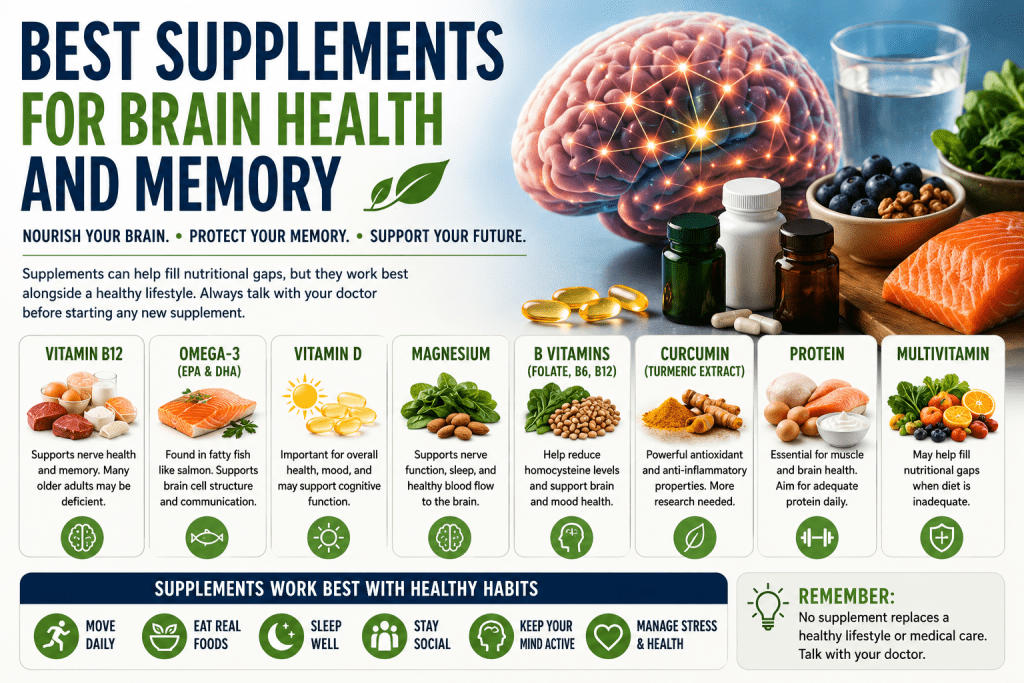
1. Vitamin B12: Important, Especially After 50
If there is one nutrient older adults should pay attention to, it is vitamin B12.
Vitamin B12 helps keep nerve cells and blood cells healthy. It also plays a role in DNA production and proper nervous system function. Adults generally need 2.4 micrograms per day, according to the NIH Office of Dietary Supplements.
Here is the catch: as people age, some have more trouble absorbing B12 from food. The National Academies notes that 10% to 30% of older adults may be unable to absorb naturally occurring vitamin B12 well, which is why people over 50 are often advised to get B12 from fortified foods or supplements.
Low B12 can sometimes cause symptoms that affect thinking, mood, energy, balance, and nerve function. That does not mean B12 is a magic memory pill. It means deficiency should not be ignored.
This is an important distinction.
If your B12 level is normal, taking extra B12 may not sharpen your memory. But if your B12 is low, correcting it may be important for your overall nerve and brain health.
Older adults who take metformin, acid-reducing medications, or eat little animal protein may especially want to ask their doctor about checking B12.
2. Omega-3 Fatty Acids: Better From Food Than Hype
Omega-3 fatty acids are often promoted for heart and brain health. The best-known forms are EPA and DHA, found in fatty fish such as salmon, sardines, trout, and mackerel.
The brain contains a lot of fat, and DHA is important in brain structure. That is why omega-3s make sense biologically.
But here is where we must separate food from supplement marketing.
The NIH Office of Dietary Supplements reports that clinical trials suggest long-chain omega-3 supplementation does not improve cognitive function in older adults who have no cognitive impairment. In one trial of cognitively healthy adults ages 70 to 79, DHA and EPA supplementation for 24 months did not significantly improve cognitive function compared with placebo.
There is also newer research raising questions about omega-3 supplementation in some older adults, though observational findings do not prove cause and effect.
So what is the practical advice?
Eating fatty fish as part of a healthy diet may still be a reasonable brain-and-heart-health habit. But taking fish oil capsules specifically to prevent memory loss is not strongly supported for otherwise healthy older adults.
Also, fish oil can interact with blood-thinning medications or increase bleeding concerns in some people, so it should not be treated like candy.
3. Vitamin D: Important for Health, Not a Memory Cure
Vitamin D is important for bone health, muscle function, immune function, and overall health. Low vitamin D is common, especially in people with limited sun exposure, darker skin, certain medical conditions, or poor dietary intake.
But when it comes to memory, vitamin D is not a simple “take this and remember everything” supplement.
Correcting a deficiency may be important for general health. However, using vitamin D as a direct memory booster is not the same thing. The brain needs a healthy body, and vitamin D may be part of that larger picture, especially for strength and fall prevention.
For older adults, the best step is often to ask your doctor whether vitamin D testing or supplementation makes sense based on your medical history, diet, sun exposure, and medications.
Do not megadose vitamin D on your own. More is not always better. Too much vitamin D can raise calcium levels and cause real problems.
4. Magnesium: Useful for the Body, Possibly Helpful Indirectly
Magnesium is involved in hundreds of processes in the body, including nerve function, muscle function, blood pressure regulation, and glucose metabolism.
Some research suggests minerals such as magnesium, zinc, selenium, iron, and copper are involved in cognitive health, especially in older adults. But the key issue is balance, not blindly taking large doses.
Magnesium may help some people with sleep quality, constipation, muscle cramps, or general metabolic health, depending on the person. Better sleep and better metabolic health may indirectly support brain function.
But again, magnesium is not a guaranteed memory supplement.
It can also interfere with certain medications, and some forms may cause diarrhea. People with kidney disease should be especially careful and speak with a healthcare professional first.
5. Folate and B Vitamins: Helpful If Deficient, But Not Guaranteed
B vitamins, including B6, B12, and folate, are involved in brain and nerve function. They also affect homocysteine, a blood marker that can rise when B12 or folate is low.
There is some interest in whether lowering homocysteine with B vitamins might help protect cognition. But the evidence is mixed.
The National Center for Complementary and Integrative Health says short-term studies suggest B-vitamin supplements do not help cognitive functioning in adults ages 50 or older, with or without dementia. However, it also notes that some longer-term evidence suggests B vitamin supplementation may be associated with slowing cognitive decline.
That is not a clean, simple answer. Welcome to nutrition science.
The practical message is this: do not assume a B-complex supplement will fix memory. But do ask your doctor whether testing B12, folate, and related markers makes sense, especially if you have fatigue, numbness, balance issues, anemia, digestive problems, or cognitive concerns.
6. Curcumin: Interesting, But Not Proven as a Dementia Preventer
Curcumin is the active compound found in turmeric. It has been studied for inflammation, oxidative stress, and possible brain health effects.
It is popular because it sounds natural, ancient, and scientific all at the same time. That combination sells bottles.
But the evidence for curcumin as a proven memory protector or dementia treatment is not strong enough to call it a sure thing. NCCIH includes curcumin among supplements studied for cognitive function, dementia, and Alzheimer’s disease, but the overall evidence for dietary supplements remains limited.
Curcumin also has absorption issues. Many formulas add black pepper extract, which can increase absorption but may also affect medication metabolism.
That matters for older adults who take blood thinners, diabetes drugs, blood pressure medications, or multiple prescriptions.
Turmeric in food is one thing. High-dose curcumin supplements are another.
7. Ginkgo Biloba: Famous, But Not Convincing
Ginkgo biloba may be the celebrity supplement of memory products. It has been promoted for decades.
But fame is not proof.
NCCIH states that there is no conclusive evidence that ginkgo biloba prevents or slows dementia or cognitive decline.
That does not mean every person who takes it is foolish. It means the claims are stronger than the proof.
Ginkgo can also increase bleeding risk and may interact with blood thinners, aspirin, NSAIDs, seizure medications, and other drugs. For older adults, that is not a small detail.
If a supplement can affect bleeding, it deserves respect.
8. Vitamin E: Be Very Careful
Vitamin E has been studied in relation to Alzheimer’s disease and cognitive decline. But vitamin E supplementation is not something older adults should casually start for brain health.
High-dose vitamin E can increase bleeding risk and may interact with blood-thinning medications. It may also be unsafe for some people depending on medical history.
The Alzheimer’s Association warns that alternative treatments and supplements marketed for Alzheimer’s and memory often raise safety and evidence concerns, especially when people use them instead of proven medical care.
Vitamin E from food, such as nuts, seeds, and healthy oils, is very different from high-dose supplements.
This is a good general rule: nutrients in food usually arrive in a package the body understands. High-dose pills can behave differently.
9. Protein: Not a “Brain Supplement,” But Very Important
Protein is not usually marketed as a brain supplement, but in Elderhood it matters.
Why? Because muscle and brain health are connected through independence, blood sugar control, mobility, fall prevention, and overall resilience.
Poor protein intake can contribute to muscle loss, weakness, frailty, and reduced activity. Less activity can worsen blood sugar, mood, sleep, and circulation. All of that can affect the brain indirectly.
For older adults, getting enough high-quality protein throughout the day may be one of the most practical “longevity nutrition” steps.
This does not mean everyone needs protein powder. Many people can get enough from eggs, Greek yogurt, cottage cheese, fish, chicken, beans, lentils, tofu, or other protein-rich foods. But some older adults with low appetite may benefit from a protein supplement if their doctor agrees.
Sometimes the best “brain supplement” is a better breakfast.
10. A Good Multivitamin: Maybe Useful, But Not a Free Pass
A basic multivitamin may help fill small nutritional gaps, especially for people with poor diets, low appetite, restricted diets, or absorption issues.
But a multivitamin should not be used as nutritional forgiveness.
You cannot eat like a raccoon in a gas station dumpster and expect one tablet to make everything right. The body is not that easily fooled.
A multivitamin may be reasonable for some older adults, but it should be checked against medications and medical conditions. Too much of certain nutrients can be harmful, especially fat-soluble vitamins like A, D, E, and K, and minerals like iron.
Most older men and postmenopausal women should not take iron unless a doctor recommends it.
What Supplements Should You Avoid for Brain Health?
Be careful with any product that says:
“Clinically proven to reverse memory loss”
“Prevents Alzheimer’s”
“Works instantly”
“Doctor hated secret”
“Ancient cure they don’t want you to know”
“Rebuilds brain cells overnight”
“Guaranteed results”
That kind of advertising should make your wallet hide under the bed.
Also be cautious with proprietary blends. These often list ingredients without clearly showing the exact amount of each ingredient. If you do not know the dose, you cannot judge the product properly.
Avoid stacking multiple brain supplements together unless your doctor or pharmacist reviews them. Many contain overlapping ingredients, which can lead to excessive doses.
The Best Brain Health Plan Is Not a Pill Plan
The best evidence for brain health still points toward lifestyle and medical risk management.
That includes:
Regular physical activity
A healthy dietary pattern
Blood pressure control
Blood sugar control
Good sleep
Hearing correction if needed
Social connection
Learning and mental stimulation
Avoiding smoking
Limiting alcohol
Treating depression
Reviewing medications that may affect memory
This is not as exciting as a shiny bottle with a golden label, but it is more honest.
The brain does not live on slogans. It lives on blood flow, oxygen, nutrients, sleep, movement, and connection.
When Should You Talk to a Doctor?
Talk to your doctor if memory problems are getting worse, interfering with daily life, causing safety concerns, or noticed by family members.
Also talk to your doctor before starting supplements if you take:
Blood thinners
Diabetes medications
Blood pressure medications
Seizure medications
Heart medications
Cancer treatments
Multiple prescriptions
Or if you have kidney disease, liver disease, bleeding problems, or upcoming surgery
You may also want to ask about testing for B12, thyroid function, vitamin D, anemia, depression, sleep apnea, medication side effects, and hearing loss. Many things can affect memory, and some are treatable.
Do not assume every memory issue is dementia. But do not ignore it either.
Bottom Line: What Are the Best Supplements for Brain Health and Memory?
The best supplements are the ones that correct a real need.
For many older adults, the most reasonable brain-health-related supplements to discuss with a doctor may include:
Vitamin B12, especially if low or at risk
Vitamin D, if deficient
Omega-3s, preferably from food, with supplements used cautiously
Magnesium, if appropriate
A basic multivitamin, if diet is poor or intake is limited
Protein support, if daily protein intake is too low
But no supplement has proven itself as a magic shield against memory loss, dementia, or Alzheimer’s disease.
The honest formula is this:
Correct deficiencies.
Support the body.
Protect blood flow.
Move daily.
Sleep well.
Eat real food.
Stay socially and mentally engaged.
Be skeptical of miracle claims.
That may not sound flashy, but it is the truth.
And when it comes to brain health, truth beats hype every time.
This article is for educational purposes only and should not be considered medical advice. Always consult with a qualified healthcare professional before starting, stopping, or changing any supplement, medication, diet, or treatment plan.
