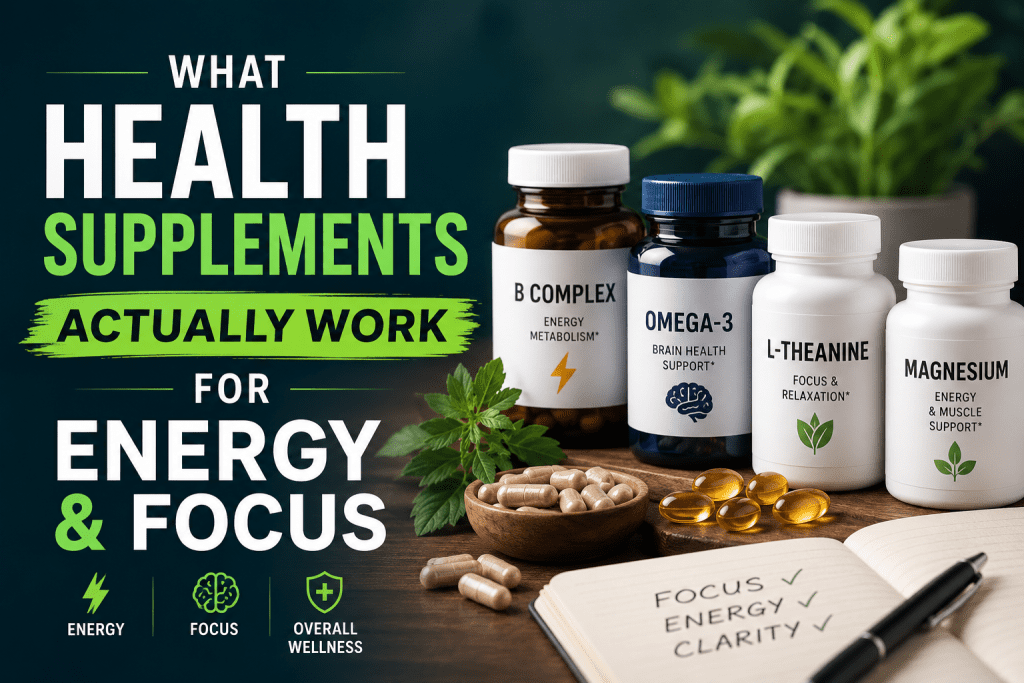
You’ve seen the ads. “Boost your energy in 30 minutes!” “Think sharper by tomorrow!” “The #1 brain supplement doctors hate!”
You’ve probably also bought a few of those products — spent $40 or $50 — and noticed absolutely nothing different three weeks later.
So let’s cut through the noise. What health supplements actually work for energy and focus? Not what’s trending, not what a 28-year-old fitness influencer is promoting, but what the science says — specifically for adults 60 and older, whose biology is genuinely different from younger people’s.
Because here’s the truth the supplement industry doesn’t want to say loudly: most energy and focus supplements on the market were designed for younger adults. Wrong forms. Wrong doses. Wrong priorities. The same ingredients that give a 35-year-old a noticeable lift may do almost nothing for someone at 65 — because the underlying problem is different.
Let’s talk about what the real problems are, and what actually helps.
Why Energy and Focus Decline With Age (It’s Not Just “Getting Old”)
Before we talk about supplements, we need to understand what’s actually happening in your body. “Aging” is too vague. There are specific, measurable reasons why energy and mental clarity often fade after 60 — and many of them are addressable.
Cellular energy production slows down. Your cells produce energy through mitochondria — tiny power plants inside each cell. As you age, mitochondrial function declines. Your cells simply make less energy. This is not a willpower issue. It is biology.
NAD+ levels drop sharply. NAD+ (nicotinamide adenine dinucleotide) is a molecule your body uses to fuel hundreds of cellular processes, including mitochondrial energy production and DNA repair. At 60, most people have roughly half the NAD+ levels of a 20-year-old. Half. This single decline accounts for a significant portion of the fatigue and brain fog that many seniors experience.
B12 absorption falls off a cliff. Vitamin B12 is essential for nerve function, red blood cell production, and energy metabolism. The problem: after 50, the stomach produces less of a protein called intrinsic factor, which is required to absorb B12 from food. You can eat plenty of B12-rich foods and still become deficient because your body can no longer absorb it effectively. B12 deficiency causes profound fatigue, brain fog, and memory issues — symptoms that are frequently dismissed as “just part of aging.”
Magnesium is depleted. Magnesium is involved in over 300 enzymatic reactions in the human body, including the production of ATP — the molecule your cells use as energy. Most Americans over 60 are deficient in magnesium, and most don’t know it because routine blood tests don’t accurately reflect magnesium stored in tissues. Deficiency causes fatigue, poor sleep, muscle weakness, and difficulty concentrating.
Inflammation increases. Chronic low-grade inflammation — sometimes called “inflammaging” — is a hallmark of aging and directly impairs cognitive function and energy. When your immune system is in a constant low-level state of alert, it draws resources away from everything else, including brain performance.
Understanding these mechanisms matters because it helps you choose supplements that address the actual problem — not just whatever happens to be on sale at the pharmacy.
The Supplements With Real Evidence
1. B12 (Methylcobalamin) — The Non-Negotiable
If you do nothing else, address B12.
The form matters enormously here. Most cheap supplements use cyanocobalamin, a synthetic form your body must convert before it can use. The superior form — and the one worth paying for — is methylcobalamin, the bioavailable form that works directly without conversion. This is especially important for the roughly 10–15% of people who have MTHFR gene variants that impair B12 conversion.
A sublingual (under-the-tongue) B12 in methylcobalamin form bypasses the absorption problem entirely — it goes directly into the bloodstream through the mucous membrane rather than relying on the gut.
If you’re B12 deficient, the effect on energy when you start supplementing can be remarkable. It typically takes 2–4 weeks to feel a significant difference.
2. NAD+ Precursors (NMN or NR) — Cellular Energy Restoration
This is arguably the most exciting area of longevity and energy research right now. NAD+ precursors — specifically NMN (nicotinamide mononucleotide) and NR (nicotinamide riboside) — are compounds your body uses to produce NAD+.
Harvard researcher David Sinclair has published extensively on NAD+ and aging. The research shows that restoring NAD+ levels can improve mitochondrial function, energy metabolism, cognitive performance, and even physical endurance in older adults.
The clinical evidence is still building, but multiple human trials have shown that NMN and NR supplementation safely raises NAD+ levels in adults. And the mechanism is well-understood: more NAD+ means better-functioning mitochondria means more cellular energy.
This is not a “wellness trend.” This is one of the most scientifically grounded approaches to age-related energy decline currently available.
3. CoQ10 — The Mitochondrial Fuel Additive
Coenzyme Q10 is produced naturally in your body and plays a central role in the electron transport chain — the process by which your mitochondria generate ATP energy. Like NAD+, CoQ10 levels decline with age. Unlike NAD+, CoQ10 is also depleted by statin medications (cholesterol-lowering drugs), which are among the most commonly prescribed medications in older adults.
If you take a statin and feel chronically fatigued or experience muscle weakness, CoQ10 deficiency is a very likely contributing factor. Many doctors now recommend CoQ10 supplementation routinely for statin users.
Look for the ubiquinol form of CoQ10 rather than ubiquinone — ubiquinol is the already-converted, active form that is significantly better absorbed, particularly in older adults whose bodies have reduced capacity to convert ubiquinone.
4. Magnesium Glycinate — The Overlooked Energy Mineral
The form matters here too. Magnesium oxide — the form found in most cheap magnesium supplements — has roughly 4% bioavailability. That means 96% of what you swallow is not absorbed. Magnesium glycinate (or magnesium malate) is absorbed far more effectively and is gentler on the digestive system.
Beyond energy, magnesium glycinate significantly improves sleep quality for most people who are deficient — and poor sleep is one of the most powerful drains on next-day energy and cognitive performance. Addressing magnesium often creates a positive cascade: better sleep → better energy → sharper focus → better mood.
5. Creatine Monohydrate — Not Just for the Gym
Most people associate creatine with young weightlifters. The emerging research tells a very different story.
Creatine is increasingly studied in older adults for both physical and cognitive benefits. It replenishes phosphocreatine in muscle and brain cells — a rapid-energy reserve your body uses for high-demand tasks. Several clinical trials have shown that creatine supplementation in older adults improves:
- Physical strength and endurance
- Processing speed and working memory
- Fatigue resistance
- Recovery after exertion
It is one of the most studied, most affordable, and safest supplements available. A low dose of 3–5 grams per day of plain creatine monohydrate (no fancy forms needed) is effective and well-tolerated. Our Brain & Body Creatine is formulated specifically for this purpose — appropriately dosed for older adults, not gym-maximized.
6. Lion’s Mane Mushroom — Nerve Growth and Brain Clarity
Lion’s Mane (Hericium erinaceus) is a medicinal mushroom with a unique mechanism: it stimulates the production of Nerve Growth Factor (NGF), a protein that supports the growth, maintenance, and repair of neurons.
Multiple clinical trials in older adults with mild cognitive impairment have shown significant improvements in cognitive function scores with Lion’s Mane supplementation. When study participants stopped taking it, scores declined again — suggesting an active rather than placebo effect.
For brain fog, mental clarity, and focus, Lion’s Mane is one of the most compelling natural options currently available with human clinical evidence.
What Doesn’t Work (And Why You Keep Buying It)
Let’s be honest about a few popular products that consistently underdeliver:
Generic “energy blends” with caffeine + B vitamins. The energy you feel is the caffeine. The B vitamins at the doses used (often a token amount printed in bold on the label) contribute almost nothing to measurable energy levels unless you were severely deficient.
Ginkgo biloba. Despite decades of popularity, the largest and most rigorous clinical trials have failed to show significant cognitive benefits in healthy older adults.
Proprietary blends. If a supplement lists 14 ingredients and won’t tell you how much of each is included, you should assume the effective ingredients are dosed at sub-therapeutic levels. The headline ingredient gets enough to appear on the label. The filler gets the rest.
The Honest Bottom Line
Supplements work best when they address a real, measurable deficiency or biological mechanism — not when they’re purchased based on marketing claims.
For seniors specifically, the supplements with the strongest evidence for energy and focus are: methylcobalamin B12, NAD+ precursors (NMN/NR), ubiquinol CoQ10, magnesium glycinate, creatine monohydrate, and Lion’s Mane mushroom.
None of these will work overnight. None of them are magic. But taken consistently at effective doses, formulated for older adult biology, they address the real reasons your energy and focus have changed — not just the symptoms.
If you’re going to invest in supplements, invest in ones that are honest about what they are, where they’re made, and what they contain. Your doctor deserves to know exactly what you’re taking. Your body deserves ingredients that were actually designed with you in mind.
That’s what we built Avidasana to be.
These statements have not been evaluated by the Food and Drug Administration. This article is for informational purposes only and is not intended to diagnose, treat, cure, or prevent any disease. Always consult your physician or pharmacist before starting any new supplement, especially if you have existing health conditions or take prescription medications.
Explore the Avidasana supplements referenced in this article:
