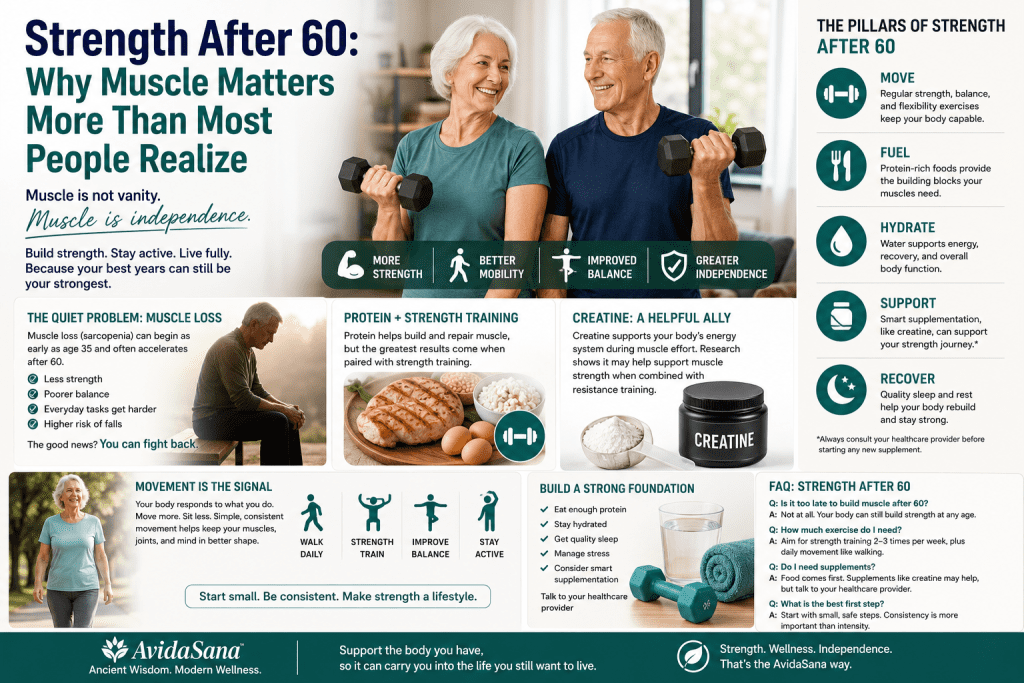
There comes a point in life when strength is no longer about looking good in a mirror.
It is about getting out of a chair without making sound effects.
It is about carrying groceries, walking with confidence, climbing stairs, opening jars, staying steady on your feet, and not feeling like your body is quietly handing in its resignation letter.
After 60, muscle is not vanity.
Muscle is independence.
And that is why strength, movement, protein, hydration, and smart supplementation deserve more attention in elderhood.
The Quiet Problem: Muscle Loss With Age
As we get older, the body naturally tends to lose muscle mass and strength. This age-related muscle loss is often called sarcopenia.
Harvard Health notes that sarcopenia can begin as early as around age 35, with muscle loss typically progressing over time and often accelerating after age 60. That is the part most people do not realize. This process does not suddenly arrive one morning wearing a name tag. It sneaks in quietly.
You may first notice it in small ways.
The stairs feel harder.
The laundry basket feels heavier.
Your balance is not what it used to be.
You avoid lifting things you used to handle easily.
You sit down more because standing feels like work.
That is not “just aging” in the lazy sense of the phrase.
It may be your body asking for support.
Strength Is a Health Asset
For seniors, strength is not just about muscles. It connects to balance, mobility, confidence, and daily living.
The National Institute on Aging explains that physical activity is important for older adults and includes endurance, strength, balance, and flexibility exercises. Strength exercises can include resistance bands, hand-held weights, weight machines, or using your own body weight.
That is important because elderhood should not be built around avoiding movement.
It should be built around protecting movement.
The less we move, the weaker we get.
The weaker we get, the less we move.
Then one day, the couch becomes a business partner.
And let me tell you, the couch is a terrible partner. It never encourages you. It just says, “Stay a little longer.”
Protein Matters, But It Is Not the Whole Story
Protein is one of the building blocks your body uses to maintain and repair muscle.
But protein alone is not enough.
Harvard Health explains that protein is important for building muscle mass, but combining protein with strength training appears to provide the greatest improvement in muscle mass and strength in healthy older adults.
That is the key.
You cannot simply eat protein and expect your muscles to throw a parade.
The body needs a reason to maintain muscle. Strength training gives it that reason.
Even simple resistance exercises, done consistently and safely, can help tell the body: “We still need this muscle. Do not put it in storage.”
Where Creatine Fits Into the Conversation
Creatine has received growing attention because it helps support the body’s energy system during short bursts of activity, especially muscle effort.
The NIH Office of Dietary Supplements describes creatine as one of the ingredients commonly used in performance supplements and explains that dietary supplements are regulated differently from drugs. The FDA does not approve supplements before they are sold, and manufacturers are responsible for safety and truthful labeling.
That matters.
Creatine is not magic. It is not a cure. It is not a promise that you will suddenly start doing push-ups like a Marine recruit.
But for some adults, especially when paired with resistance training, creatine may be part of a broader strength-support routine.
A review published in the scientific literature found that creatine supplementation has potential to support aging muscle mass and strength, especially when combined with resistance training.
The practical message is simple:
Creatine works best as part of a routine, not as a replacement for one.
Movement Is the Signal
Your body listens to what you do.
If you walk, stretch, lift, climb, balance, and move, your body gets the message that strength still matters.
If you spend most of the day sitting, your body gets a different message.
That does not mean you need to become a gym warrior. Nobody is asking you to wear spandex and start yelling “beast mode” at 7 in the morning.
Start smaller.
Stand up from a chair without using your hands, if safe.
Use light resistance bands.
Walk daily.
Practice balance near a stable surface.
Carry light groceries carefully.
Do simple wall push-ups.
Use small dumbbells if approved by your doctor.
The goal is not punishment.
The goal is preservation.
Hydration and Energy Matter Too
Muscles do not work in isolation.
They need fluid, minerals, fuel, rest, and recovery.
Many older adults do not drink enough water. Some are afraid of drinking too much because they do not want extra bathroom trips. Understandable, but dehydration can make fatigue, weakness, dizziness, and confusion worse.
Food matters too.
A strength-supporting lifestyle usually includes:
Enough protein
Whole grains
Fruits and vegetables
Healthy fats
Adequate fluids
Regular movement
Good sleep
Smart supplementation when appropriate
No supplement can fix a lifestyle that is falling apart at the seams.
But the right supplement can support a good routine.
That is the honest way to look at it.
The AvidaSana Philosophy: Ancient Wisdom, Modern Wellness
At AvidaSana, we believe wellness after 60 should be practical, respectful, and rooted in reality.
Not hype.
Not miracle claims.
Not fear.
The body changes with age, but that does not mean we should surrender.
Elderhood is not the end of effort. In many ways, it is when effort matters most.
A simple routine can make a difference:
Move daily.
Build strength safely.
Eat enough protein.
Stay hydrated.
Sleep well.
Support your body wisely.
Talk to your healthcare provider before starting new supplements, especially if you take medication or have kidney disease, heart disease, diabetes, or other medical conditions.
That is not glamorous advice.
But it is the kind of advice that keeps people standing, walking, thinking, and living.
The Bottom Line
After 60, strength is not about ego.
It is about freedom.
Freedom to move.
Freedom to travel.
Freedom to live at home.
Freedom to carry your own groceries.
Freedom to get up from a chair without needing a committee meeting.
Muscle matters because independence matters.
And the best time to protect your strength is before you desperately need it.
AvidaSana’s message is simple:
Support the body you have, so it can carry you into the life you still want to live.
Ancient Wisdom. Modern Wellness.
FAQ: Strength, Muscle, and Wellness After 60
Why does muscle matter more after 60?
Muscle helps support balance, mobility, posture, strength, and independence. As people age, loss of muscle can make everyday activities harder, including walking, climbing stairs, carrying groceries, and getting up from a chair.
Is muscle loss a normal part of aging?
Some muscle loss is common with aging, but that does not mean seniors should ignore it. Strength training, adequate protein, movement, and healthy habits can help support muscle and function over time.
What kind of exercise helps maintain muscle?
Strength exercises are especially important. These may include resistance bands, light weights, weight machines, chair exercises, wall push-ups, or bodyweight movements. Older adults should start safely and ask a healthcare provider before beginning if they have health concerns.
Is protein important after 60?
Yes. Protein helps the body maintain and repair muscle. But protein works best when combined with strength training and an overall healthy lifestyle.
What is creatine?
Creatine is a compound involved in the body’s energy system, especially during short bursts of muscle activity. It is also sold as a dietary supplement. Some research suggests creatine may support strength-related goals when combined with resistance training.
Is creatine safe for seniors?
Many people use creatine, but seniors should speak with a healthcare professional before starting, especially if they have kidney disease, take prescription medications, or have other medical conditions.
Can supplements replace exercise?
No. Supplements should not replace movement, strength training, good nutrition, hydration, or medical care. They may support a healthy routine, but they do not do the work for you.
What is the best first step for seniors who feel weaker?
Start with a safe movement routine. Walking, light strength exercises, balance practice, and better nutrition can all help. Anyone with medical issues, dizziness, falls, or sudden weakness should speak with a healthcare provider.
Read Other Blog:- Read Now
