Aging is not just about birthdays.
It is about what your body can still do.
Can you get out of a chair without making that little “old-man sound”?
Can you carry groceries without feeling like you just completed military training?
Can you walk, balance, bend, lift, think clearly, and keep your independence?
That is the real question.
After 60, the body changes. Muscle can decline. Bones need support. Energy can dip. Digestion may not work like it did at 35. And the body often needs more nutritional attention, not less.
This is why AvidaSana believes in a simple idea:
Modern wellness begins with giving the aging body better daily support.
Not magic.
Not miracle promises.
Not “take this and become 25 again,” which is nonsense unless someone also invents a time machine and a better haircut.
We are talking about practical support: protein, movement, key nutrients, hydration, and daily habits that help the body remain strong, steady, and active.
That is where the old wisdom and modern science meet.
Aging Is Not the Enemy. Weakness Is.
There is nothing wrong with aging.
Aging means you made it this far, which is no small achievement. The problem is not age itself. The problem is losing strength, confidence, balance, and independence.
One of the biggest challenges of later life is muscle loss.
Researchers often use the word sarcopenia to describe age-related loss of muscle mass and strength. It is a fancy word, but the real-life meaning is simple: less muscle can make everyday life harder.
Less muscle can mean:
Getting tired faster
Trouble climbing stairs
Difficulty carrying bags
Poorer balance
Greater fall risk
Less confidence moving around
Feeling older than you need to feel
And here is the part many people miss: muscle is not just about looking strong. Muscle is about living strong.
Muscle helps you move, stand, stabilize, recover, and stay independent.
The National Institute on Aging has highlighted that strength training may contribute to healthier bodies as people age, and researchers continue studying how resistance training supports function and physical health in later life.
That is a big deal.
Because after 60, “I just want to stay independent” may be the most important fitness goal of all.
The Body Needs Protein More Than People Realize
Many seniors grew up thinking protein was mainly for bodybuilders, athletes, or young men grunting in gyms while staring at themselves in mirrors.
But protein is not just for bodybuilders.
Protein is for bodies.
Your muscles, bones, skin, immune system, and repair processes all need protein.
Research published through the National Institutes of Health notes that higher dietary protein, up to about 1.2 grams per kilogram of body weight per day, may help prevent sarcopenia and support musculoskeletal health in older adults.
That does not mean everyone should suddenly start eating like a football player.
It means older adults should pay attention.
Many seniors eat too little protein because they eat smaller meals, skip meals, live alone, have dental problems, lose appetite, or simply fall into old habits.
A cup of coffee and toast may feel like breakfast, but it is not exactly a construction crew for your muscles.
After 60, every meal should earn its place.
That does not mean complicated eating. It means smarter eating.
Why Strength Training Matters After 60
Walking is wonderful.
Walking helps the heart, circulation, mood, blood sugar, and endurance.
But walking alone may not be enough to preserve muscle strength.
The CDC recommends that adults 65 and older get at least 150 minutes of moderate-intensity aerobic activity each week, plus at least 2 days of muscle-strengthening activity and balance activities.
That is the key phrase: muscle-strengthening activity.
This can include:
Resistance bands
Light dumbbells
Weight machines
Chair squats
Wall pushups
Step-ups
Bodyweight exercises
Functional movement
No one is saying you need to become Mr. Olympia at 72.
The goal is not to impress teenagers at the gym.
The goal is to keep getting out of your chair, walking safely, lifting groceries, reaching shelves, and living your life without shrinking your world.
Strength is freedom.
And weakness is expensive.
The Vitamin D Connection
Vitamin D is another nutrient older adults need to understand.
The NIH Office of Dietary Supplements explains that vitamin D helps the body absorb calcium, supports bone health, and is needed for muscle movement and nerve communication. Adults age 71 and older are generally recommended to get 20 mcg, or 800 IU, per day.
Vitamin D is not glamorous.
Nobody throws a party and says, “Come celebrate my serum vitamin D level.”
But it matters.
Low vitamin D can affect bones and muscle function. And when bones are weaker and muscles are weaker, the risk of falls and fractures becomes more serious.
That is why older adults should ask their healthcare provider whether their vitamin D level should be checked, especially if they get little sunlight, have darker skin, have certain digestive conditions, take certain medications, or spend most of their time indoors.
One caution: more is not always better.
The NIH warns that excessive vitamin D intake can be toxic and may lead to high calcium levels and serious complications.
So the goal is not megadosing.
The goal is balance.
That is true wellness.
The AvidaSana View: Support the Body Before It Complains
Most people wait until the body starts yelling before they pay attention.
The knee hurts.
The back aches.
The energy disappears.
The stairs become an enemy.
The doctor gives “the look.”
Then suddenly everybody wants a plan.
But the smarter approach is to support the body before it stages a protest.
That is the heart of AvidaSana’s philosophy:
Ancient Wisdom. Modern Wellness.
Ancient wisdom reminds us that daily habits matter.
Modern wellness reminds us that the body has real biological needs.
Together, they tell us something simple:
You cannot neglect the body for 20 years and expect it to send you a thank-you card.
The body keeps records.
But the good news is, the body also responds to better habits.
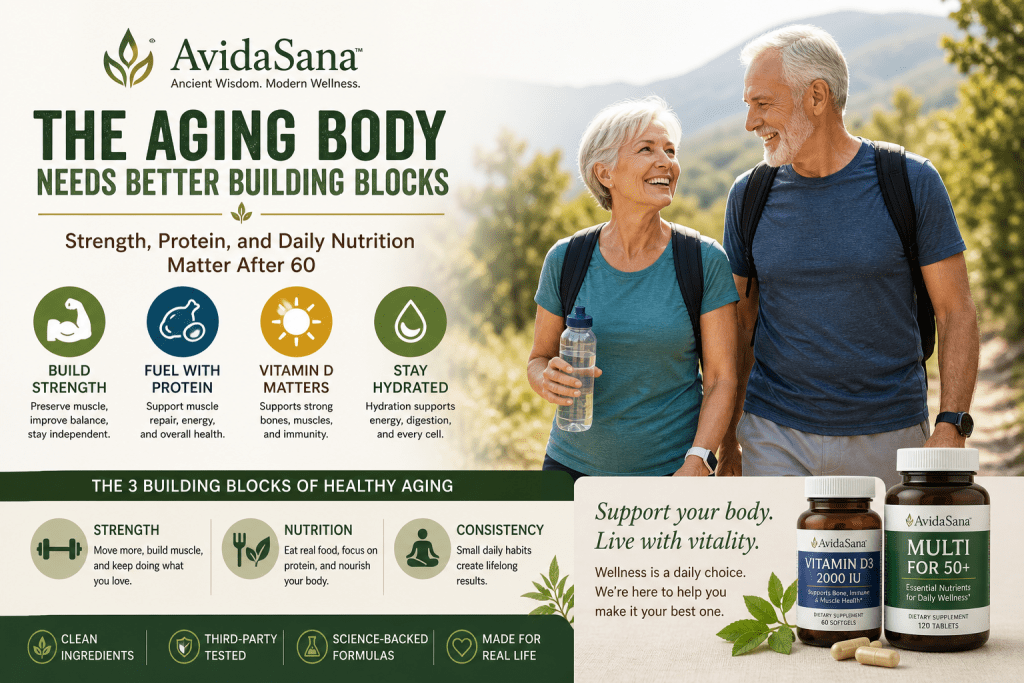
The Three Building Blocks of Healthy Aging
Healthy aging does not need to be complicated.
For many older adults, the foundation comes down to three building blocks.
1. Strength
The aging body needs movement that challenges the muscles.
Not punishment.
Not exhaustion.
Challenge.
Two days a week of strength activity can make a meaningful difference when done consistently and safely.
2. Nutrition
The body needs enough protein, fiber, vitamins, minerals, and fluids.
This becomes even more important when appetite declines or meals become smaller.
Eating less is not always the goal.
Eating better is the goal.
3. Consistency
This is the part nobody wants to hear because it does not sound exciting.
But consistency wins.
The body does not care what you promised on Monday.
The body responds to what you repeat.
A walk once in a while is nice.
A daily walking habit is better.
A healthy meal once a week is nice.
A steady nutrition routine is better.
A supplement bottle in the cabinet is nice.
Taking the right supplement consistently, when appropriate for your needs, is better.
The boring stuff works.
That is the unfair truth of health.
Where Supplements Can Fit
Supplements are not a replacement for food.
They are not a replacement for exercise.
They are not a replacement for medical care.
But good supplements can help fill nutritional gaps when diet alone is not enough.
That is especially relevant for older adults who may struggle with appetite, food variety, absorption, or consistency.
AvidaSana’s role is to support a wellness lifestyle built around better daily habits.
The right mindset is:
Food first.
Movement daily.
Sleep seriously.
Hydration regularly.
Supplements thoughtfully.
Doctor guidance when needed.
That is a grown-up wellness plan.
Not hype.
Not fear.
Not miracle language.
Just practical support for the aging body.

Why “Feeling Older” Is Sometimes a Signal
Many people say, “I guess I’m just getting old.”
Sometimes that is true.
But sometimes what feels like “getting old” may be poor sleep, low activity, weak muscles, low protein intake, dehydration, stress, medication side effects, or nutrient gaps.
That does not mean supplements solve everything.
They do not.
But it does mean we should be careful before blaming everything on age.
Age gets blamed for a lot of crimes it did not commit.
Sometimes the real culprit is neglect.
Sometimes it is inactivity.
Sometimes it is poor nutrition.
Sometimes it is not enough recovery.
And sometimes it is simply that nobody ever explained what the aging body needs.
That is why education matters.
A Simple Daily Plan for Better Aging
Here is a simple plan that many older adults can discuss with their healthcare provider and adapt to their own situation.
Start the day with protein.
Walk most days.
Do strength activity twice a week.
Drink water before you feel thirsty.
Get sunlight safely when possible.
Prioritize sleep.
Review medications with your doctor.
Ask whether vitamin D, B12, or other nutrient levels should be checked.
Use supplements only as support, not as magic.
Keep moving, even if you move slowly.
Slow movement still counts.
The body does not require perfection.
It requires participation.
And that is good news, because perfection is exhausting.
Final Thoughts
The aging body is not broken.
But it does need better support.
After 60, strength matters. Protein matters. Vitamin D matters. Movement matters. Hydration matters. Consistency matters.
AvidaSana stands for a practical kind of wellness: respect the wisdom of the past, but use the knowledge of today.
That is what Ancient Wisdom, Modern Wellness really means.
It means honoring the body.
It means staying active.
It means making better choices before trouble arrives.
It means refusing to accept unnecessary weakness as “just aging.”
Because the goal is not simply to live longer.
The goal is to live stronger.
And that begins with the building blocks you give your body every day.

FAQ Section
Why does muscle matter so much after 60?
Muscle helps with strength, balance, mobility, metabolism, and independence. Age-related muscle loss can make everyday activities harder, which is why strength training and adequate nutrition are important for healthy aging.
Do seniors need more protein?
Many older adults may benefit from paying closer attention to protein intake. Research suggests that higher dietary protein, up to about 1.2 grams per kilogram of body weight per day, may help support muscle health in older adults.
Is walking enough for healthy aging?
Walking is excellent, but older adults are also advised to include muscle-strengthening activities. The CDC recommends adults 65 and older get at least 150 minutes of moderate-intensity aerobic activity each week, plus at least 2 days of strength activity and balance work.
Why is vitamin D important for older adults?
Vitamin D helps the body absorb calcium, supports bone health, and is needed for muscle movement and nerve communication. Adults age 71 and older are generally recommended to get 20 mcg, or 800 IU, per day.
Can I take a lot of vitamin D to feel better faster?
No. More is not always better. Excess vitamin D can be toxic and may cause serious problems, including high calcium levels. It is best to discuss testing and supplementation with a healthcare provider.
Do supplements replace food?
No. Supplements should support a healthy lifestyle, not replace balanced meals. Food, movement, hydration, sleep, and medical guidance remain the foundation.
Can strength training be safe for seniors?
Many older adults can safely do strength-building activities when they start gradually and choose exercises appropriate for their ability. People with medical conditions should ask their healthcare provider before beginning a new exercise program.
What is the simplest first step?
Start with one small habit: add protein to breakfast, take a short walk, drink more water, or do gentle strength exercises twice a week. Small habits repeated consistently can become powerful over time.
Read Other Blog:- Read Now
