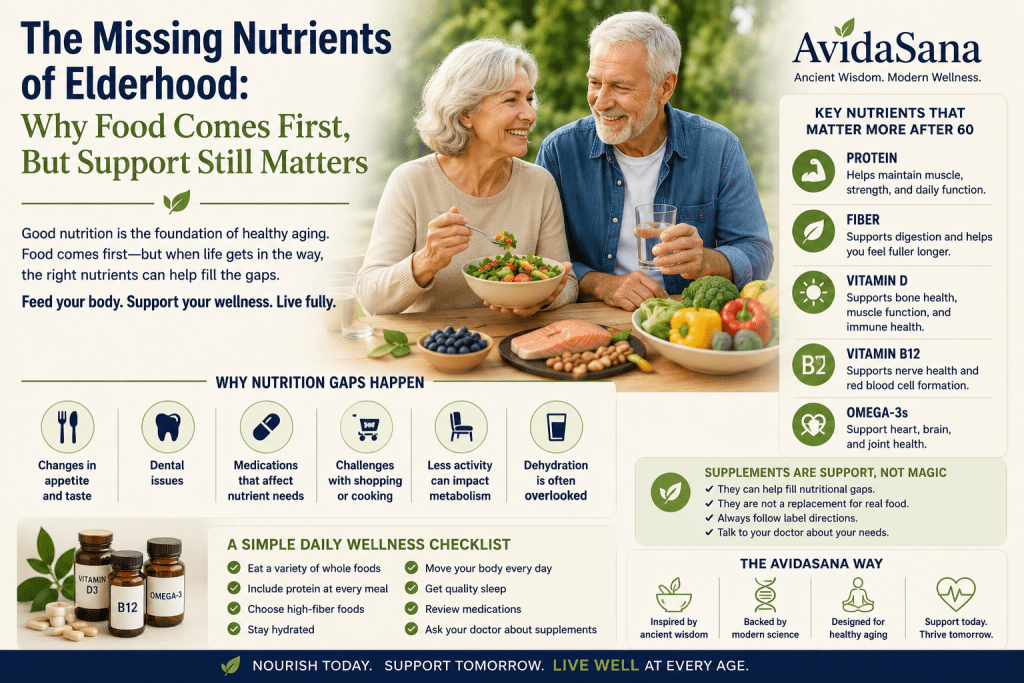
There comes a point in life when your body becomes a little less forgiving.
At 25, you could eat pizza at midnight, sleep five hours, and still bounce out of bed like a Labrador puppy.
After 60?
One bad meal, one poor night’s sleep, and your body sends a committee to complain.
That does not mean aging is a disaster. It means the body needs better support.
For many older adults, the real problem is not one dramatic deficiency. It is the slow, quiet gap between what the body needs and what the daily diet actually provides.
That is where the conversation about nutrition, healthy aging, and supplements begins.
Not with hype.
Not with miracle claims.
With common sense.
Food Comes First
Before we talk about supplements, let’s say the honest thing first:
Food comes first.
The National Institute on Aging encourages older adults to focus on healthy food choices, including fruits, vegetables, grains, protein foods, dairy or fortified alternatives, and healthy oils. Older adults also need enough fluids, fiber, vitamins, and minerals to support everyday health.
That means the foundation is still real food.
Vegetables.
Fruit.
Protein.
Beans.
Eggs.
Fish.
Nuts.
Whole grains.
Water.
Nothing glamorous. Nothing that needs a drumroll.
Just the basic building blocks your body has been asking for since Eisenhower was president.
But Real Life Gets in the Way
Here is where things get practical.
Many older adults do not eat perfectly every day.
Appetite may change.
Taste may change.
Digestion may change.
Dental issues may affect food choices.
Medication schedules may interfere with meals.
Cooking for one can feel discouraging.
Shopping may become harder.
Protein intake may drop.
Hydration may be overlooked.
And let’s be honest: some days dinner becomes toast, tea, and whatever looked familiar in the refrigerator.
That is not a moral failure. That is life.
But over time, small nutrition gaps can matter.
Why Protein Matters More With Age
Protein is one of the most important nutrients for older adults because it helps support muscle maintenance.
As people age, preserving muscle becomes essential for strength, balance, independence, and daily energy. The American Heart Association has reported that protein needs become increasingly important as muscle mass declines with age, and many older adults do not get enough.
This does not mean everyone needs to eat like a bodybuilder carrying a gallon jug around the gym.
It means older adults should make protein a regular part of meals.
Good protein sources include:
Eggs
Fish
Chicken
Turkey
Greek yogurt
Cottage cheese
Beans
Lentils
Tofu
Nuts and seeds
The simple rule: do not let breakfast be lonely. Give it some protein.

Fiber Is the Quiet Hero
Fiber does not get much applause, but it deserves a standing ovation.
Fiber supports digestive regularity and helps you feel fuller after meals. The FDA gives “fiber maintains bowel regularity” as an example of a structure/function claim that describes how a nutrient supports normal body function.
Fiber-rich foods include:
Oats
Beans
Lentils
Berries
Apples
Vegetables
Whole grains
Chia seeds
Flaxseed
The problem is many people eat too little fiber because modern food is often soft, processed, and stripped down.
In plain English: if your food could survive three years in a vending machine, it may not be doing your digestion any favors.
Vitamin D Deserves Attention
Vitamin D supports bone health, muscle function, and immune system function.
Older adults may be at greater risk of low vitamin D intake or low vitamin D status because of reduced sun exposure, diet patterns, and changes in the body. NIH notes that vitamin D is available in supplements as D2 or D3, and both can raise vitamin D blood levels. Research cited by NIH indicates D3 may raise and maintain those levels more effectively than D2.
But this is also where common sense matters.
Do not guess blindly.
If you are concerned about vitamin D, ask your doctor whether testing makes sense, especially if you have bone health concerns, take medications, or have medical conditions.
Vitamin B12 Can Become More Important Later in Life
Vitamin B12 helps support normal nerve function and red blood cell formation.
As people age, some have a harder time absorbing B12 from food. The National Institute on Aging notes that some older adults may need B12 from fortified foods or dietary supplements because the body may not absorb enough naturally occurring B12 from food.
This is not a small issue.
Low B12 can sometimes be confused with “just getting older,” because symptoms may include tiredness or nerve-related complaints. That does not mean B12 is the answer for everyone. It means it is worth discussing with a healthcare professional if there are concerns.
Magnesium, Omega-3s, and Other Nutrients
Many older adults also hear about magnesium, omega-3 fatty acids, probiotics, calcium, zinc, and other nutrients.
Some may be helpful depending on the person, their diet, and their health status.
But here is the important point:
A supplement should support a healthy routine. It should not replace one.
A capsule cannot undo a poor diet, no movement, poor sleep, dehydration, and stress.
That would be convenient, but so would a remote control that finds your reading glasses.
We do not have that either.
Supplements Are Support, Not Magic
The National Institute on Aging explains that dietary supplements can include vitamins, minerals, fiber, amino acids, herbs, enzymes, and other substances used to add nutrients to the diet or help lower certain health risks.
That is a useful definition.
Supplements can help fill gaps.
But they are not medicine. They are not magic. They are not a license to ignore food, movement, sleep, hydration, or medical care.
The FDA also makes an important distinction: dietary supplements may use structure/function claims, such as supporting normal body structure or function, but they cannot claim to diagnose, treat, cure, or prevent disease.
That distinction matters.
At AvidaSana, the message should be clear:
Support wellness.
Support healthy routines.
Support better daily habits.
Do not promise miracles.
That is how trust is built.

The AvidaSana Way: Ancient Wisdom, Modern Wellness
AvidaSana is built around a simple idea:
The body needs daily care.
Not panic care.
Not miracle care.
Daily care.
Ancient wisdom has always taught that health is built through rhythm: nourishment, movement, rest, patience, and consistency.
Modern science may use different words, but the message often circles back to the same truth:
Your daily habits matter.
AvidaSana’s role is to support that daily rhythm with products designed for adults who want to age with more energy, more confidence, and more respect for the body they live in.
Not to chase youth.
To support elderhood.
There is a difference.
A Simple Daily Wellness Checklist
Before adding any supplement, older adults should ask:
Am I eating enough protein?
Am I getting enough fiber?
Am I drinking enough water?
Am I moving every day?
Am I sleeping well?
Am I taking medications that interact with supplements?
Have I discussed concerns with my doctor or pharmacist?
That last question matters.
Supplements can interact with medications. They may not be appropriate for everyone. More is not always better.
The goal is not to fill the kitchen cabinet with bottles until it looks like a tiny pharmacy.
The goal is thoughtful support.
How to Choose Supplements Wisely
When choosing a supplement, look for simple, sensible factors:
Clear labeling
Reasonable dosage
No wild miracle claims
Ingredients you understand
A brand that communicates honestly
Products that fit your actual needs
Be skeptical of anything that promises overnight transformation.
If a supplement ad sounds like it was written by a carnival barker with a lab coat, step back.
Healthy aging is not built overnight.
It is built one good decision at a time.
Final Thoughts
Elderhood is not about giving up on the body.
It is about listening more carefully.
Food comes first.
Protein matters.
Fiber matters.
Vitamin D and B12 deserve attention.
Hydration matters.
Movement matters.
Sleep matters.
Supplements can support the routine, but they should not replace it.
AvidaSana’s message is simple:
Support the body daily.
Respect the aging process.
Use wisdom.
Use science.
And do not fall for nonsense wrapped in shiny packaging.
Because after 60, health is not about doing everything perfectly.
It is about doing the important things consistently.
And that, my friend, is how you stay in the game.

FAQ
Do seniors need dietary supplements?
Some older adults may benefit from supplements, but needs vary by diet, health status, medications, and medical history. Food should come first, and supplements should be discussed with a healthcare professional.
What nutrients are important for older adults?
Protein, fiber, vitamin D, vitamin B12, calcium, potassium, healthy fats, and fluids are commonly important for older adults. Individual needs vary.
Why is protein important in elderhood?
Protein helps support muscle maintenance, strength, and daily function. Preserving muscle becomes more important with age.
Why do older adults need fiber?
Fiber supports digestive regularity and helps people feel fuller after meals. Fiber-rich foods include oats, beans, vegetables, berries, and whole grains.
Is vitamin D important for seniors?
Yes. Vitamin D supports bone health, muscle function, and immune system function. Some older adults may need testing or supplementation under medical guidance.
Why is vitamin B12 a concern for older adults?
Some older adults have difficulty absorbing naturally occurring B12 from food. B12 supports normal nerve function and red blood cell formation.
Can supplements replace a healthy diet?
No. Supplements are meant to support the diet, not replace food, movement, sleep, hydration, or medical care.
Are dietary supplements regulated like drugs?
No. Dietary supplements are regulated differently from prescription drugs. They cannot legally claim to diagnose, treat, cure, or prevent disease.
Should I ask my doctor before taking supplements?
Yes, especially if you take medications, have medical conditions, are scheduled for surgery, or are already using multiple supplements.
Read Other Blog:- Read Now
