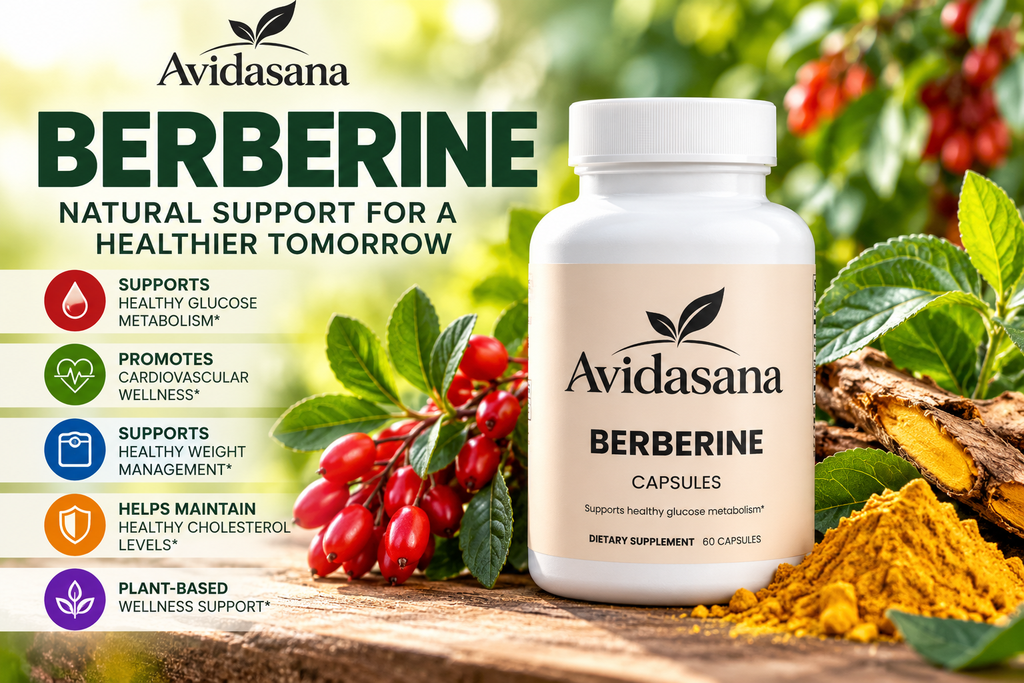
Berberine has become one of the most talked about supplements in the metabolic health world.
Some people call it “nature’s metformin.”
Others promote it for blood sugar, cholesterol, weight loss, or insulin resistance.
That kind of language gets attention.
But it can also oversimplify the science.
Berberine is interesting.
It is biologically active.
It has been studied in humans.
And some of the results are promising.
But berberine is not a miracle, and it should not be treated as a substitute for prescription medication or medical care.
That is the sensible place to begin.
If you are considering Avidasana Berberine, the goal should be to understand what berberine is, what researchers have found so far, and whether it fits safely into your overall health plan.
What Is Berberine?
Berberine is a naturally occurring compound found in several plants, including barberry, goldenseal, Oregon grape, goldthread, and tree turmeric.
Plants containing berberine have been used for centuries in traditional Chinese and Ayurvedic medicine.
Today, berberine is sold widely as a dietary supplement and is being studied for its possible effects on blood glucose, insulin resistance, cholesterol, cardiovascular risk factors, and body weight. NCCIH
That does not mean every traditional use has been proven scientifically.
It means berberine is a compound researchers consider biologically interesting enough to study seriously.
And that distinction matters.
Why Has Berberine Become So Popular?
The modern interest in berberine largely comes from metabolic health research.
People are increasingly concerned about:
- Prediabetes
- Type 2 diabetes
- Insulin resistance
- Elevated triglycerides
- High cholesterol
- Weight gain
- Metabolic syndrome
Berberine has attracted attention because some studies suggest it may affect several of these areas at the same time.
That is unusual enough to make people curious.
But curiosity should not become exaggeration.
The internet has a habit of turning “promising research” into “proven cure” in about three clicks.
Berberine deserves better than that.
What Does the Research Say About Blood Sugar?
This is probably the most studied area.
The National Center for Complementary and Integrative Health notes that a 2021 review of 46 studies involving more than 4,000 participants found that berberine may help reduce blood glucose, improve insulin resistance, and improve lipid metabolism in people with type 2 diabetes. The agency also emphasizes that many of those studies had limitations, including inconsistent results, variable quality, and populations concentrated largely in China. NCCIH
A more recent meta analysis involving 50 studies and more than 4,000 participants also found improvements in fasting glucose, post meal glucose, cholesterol, triglycerides, and some other metabolic markers. PubMed Central (PMC)
That is encouraging.
But here is the important point:
Encouraging is not the same as definitive.
Research quality matters.
Study size matters.
Duration matters.
Dosage matters.
Population matters.
And results from a supplement used in one group of people do not automatically apply to everyone.
Is Berberine Really “Nature’s Metformin”?
That phrase has become popular online.
It is catchy.
It is also misleading.
Metformin is a prescription medication with decades of clinical use, standardized dosing, regulatory oversight, extensive safety data, and clear medical indications.
Berberine is a dietary supplement.
The two should not be treated as interchangeable.
They may influence some overlapping metabolic pathways, but that does not make one a natural version of the other.
Calling berberine “nature’s metformin” may encourage people to stop or avoid prescribed treatment.
That is not a responsible message.
A better description is:
Berberine is a plant derived compound being studied for metabolic effects.
Less dramatic.
More accurate.
What About Insulin Resistance?
Insulin resistance occurs when cells become less responsive to insulin.
The pancreas may compensate by producing more insulin.
Over time, that can contribute to elevated blood glucose and type 2 diabetes in some people.
Some research suggests berberine may improve measures related to insulin sensitivity or insulin resistance, particularly in people who already have metabolic abnormalities. NCCIH
But again, berberine should not be viewed as a replacement for the basics.
Weight management.
Physical activity.
Muscle preservation.
Adequate sleep.
Diet quality.
Medication when needed.
Those factors remain fundamental.
A supplement may support a plan.
It should not become the plan.
What About Cholesterol and Triglycerides?
Berberine has also been studied for blood lipids.
The NCCIH notes that some evidence suggests berberine may modestly reduce cholesterol levels. NCCIH
The recent meta analysis mentioned earlier also found reductions in LDL cholesterol, total cholesterol, and triglycerides among study participants. PubMed Central (PMC)
That makes berberine interesting for people concerned about metabolic health more broadly.
But if you take a statin or another cholesterol medication, do not assume berberine is automatically safe to add.
Supplements and prescription medications can interact.
That is why reviewing the full supplement label with your doctor or pharmacist matters.
What About Weight Loss?
This is where marketing tends to get ahead of the evidence.
Berberine is widely promoted online as a weight loss supplement.
Some studies suggest it may have a modest effect on weight or body mass index.
But the NCCIH says the evidence is not conclusive.
A 2022 review found reductions in weight and BMI in some studies, particularly at higher doses and longer durations, but many of those studies had a high risk of bias and inconsistent results. NCCIH
So if someone is selling berberine as a dramatic weight loss solution, skepticism is appropriate.
That does not mean it has no effect.
It means the evidence is not strong enough to justify miracle claims.
Berberine Is Not a GLP 1 Drug
Another common internet comparison is between berberine and GLP 1 medications.
That comparison is even more misleading.
Prescription GLP 1 drugs such as semaglutide or tirzepatide have been studied in large clinical trials and produce effects far beyond what has been established for berberine.
Berberine may influence metabolic processes.
That does not make it a natural substitute for a GLP 1 medication.
People taking prescription weight loss or diabetes medications should be especially careful about combining them with supplements that may also influence blood glucose.
Possible Side Effects
Natural does not mean side effect free.
The most commonly reported side effects of berberine are gastrointestinal.
These can include:
- Nausea
- Abdominal discomfort
- Bloating
- Constipation
- Diarrhea
These effects are generally mild to moderate in research studies, but they can still be unpleasant. NCCIH
If you begin taking berberine and develop persistent gastrointestinal problems, do not assume you simply have to tolerate them.
Talk with your healthcare professional.
Medication Interactions Matter
This is one of the most important sections of the article.
Berberine can interact with medications.
The NCCIH specifically notes an interaction with cyclosporine, a medication used in transplant patients, and more broadly advises people taking medications to consult a healthcare professional before using berberine. NCCIH
This matters especially for people who take:
- Diabetes medications
- Blood pressure medications
- Cholesterol medications
- Blood thinners
- Immunosuppressants
- Multiple prescription drugs
The exact interaction risk depends on the medication and the person.
That is why “it is natural” is not an adequate safety assessment.
Natural substances can be pharmacologically active.
Berberine is one of them.
Pregnancy and Breastfeeding
Berberine should not be used during pregnancy or breastfeeding, and it should not be given to infants.
Exposure to berberine has been associated with dangerous bilirubin buildup in infants, which can lead to serious neurological complications. NCCIH
This is not a minor warning.
It is an important safety issue.
Quality Matters With Supplements
Unlike prescription medications, dietary supplements do not go through the same approval process before reaching consumers.
The NCCIH notes that manufacturers are not required to prove safety and effectiveness before many supplements are marketed. NCCIH
That makes product quality especially important.
When choosing a berberine supplement, look for:
- Clear ingredient labeling
- Clearly stated dosage
- Transparent manufacturing information
- Sensible claims
- No promises to cure diabetes
- No suggestion that you stop prescribed medication
A credible supplement company should not need outrageous claims.
The product should stand on transparent information.
How Berberine Fits Into a Healthy Lifestyle
If someone chooses to use berberine, it makes the most sense as one part of a larger metabolic health strategy.
That strategy may include:
Regular walking.
Resistance exercise.
Maintaining muscle.
Eating more fiber.
Reducing excessive refined carbohydrates.
Adequate sleep.
Maintaining a healthy weight.
Monitoring blood pressure.
Monitoring cholesterol.
Knowing your fasting glucose.
Knowing your A1C.
Taking prescribed medications when appropriate.
That is the foundation.
Berberine may be a supportive addition.
The foundation still matters most.
Know Your Numbers
If you are considering berberine because you are worried about blood sugar, do not guess.
Get tested.
A fasting glucose level and A1C can tell you far more than symptoms alone.
Prediabetes and type 2 diabetes can exist for years before someone feels obviously unwell.
Knowing your numbers gives you something objective to work with.
The same applies to cholesterol and triglycerides.
If you are going to use a supplement for metabolic support, it makes sense to know what your metabolic markers actually are.
Otherwise, how would you know whether anything changed?
Do Not Replace Proven Treatment
The NCCIH specifically warns against diabetes products that claim to “cure” diabetes or replace medication. Products marketed that way can be dangerous if people abandon effective treatment. NCCIH
That is worth repeating.
If you have diabetes, high cholesterol, high blood pressure, or another diagnosed medical condition, do not stop medication because you started taking berberine.
Discuss changes with your physician.
The goal is not to choose between conventional medicine and supplements.
The goal is to use good judgment.
Who Should Be Especially Careful?
Talk with your healthcare professional before using berberine if you:
Take prescription medications.
Use diabetes medication.
Take insulin.
Take multiple medications.
Have liver or kidney problems.
Are preparing for surgery.
Are pregnant.
Are breastfeeding.
Are considering giving the product to a child.
This is exactly the kind of supplement where professional review makes sense.
The Bottom Line
Berberine is not nonsense.
There is real research behind it.
Some studies suggest potentially useful effects on blood glucose, insulin resistance, cholesterol, triglycerides, and other metabolic markers. NCCIH
But berberine is also not magic.
The evidence on weight loss remains uncertain, and some of the research on metabolic outcomes has important limitations. NCCIH
That leaves us with a sensible conclusion.
Berberine may have a place in a well planned wellness program.
It should not replace medical treatment.
It should not replace exercise.
It should not replace good nutrition.
And it should not be taken casually by someone using prescription medications without checking for interactions.
If you are interested in adding berberine to your wellness routine, you can learn more about Avidasana Berberine.
Then do something simple that too many people skip:
Show the label to your doctor or pharmacist.
That one conversation may be more valuable than a hundred social media claims.
Because good health decisions should be based on evidence, context, and common sense.
Not hype.
