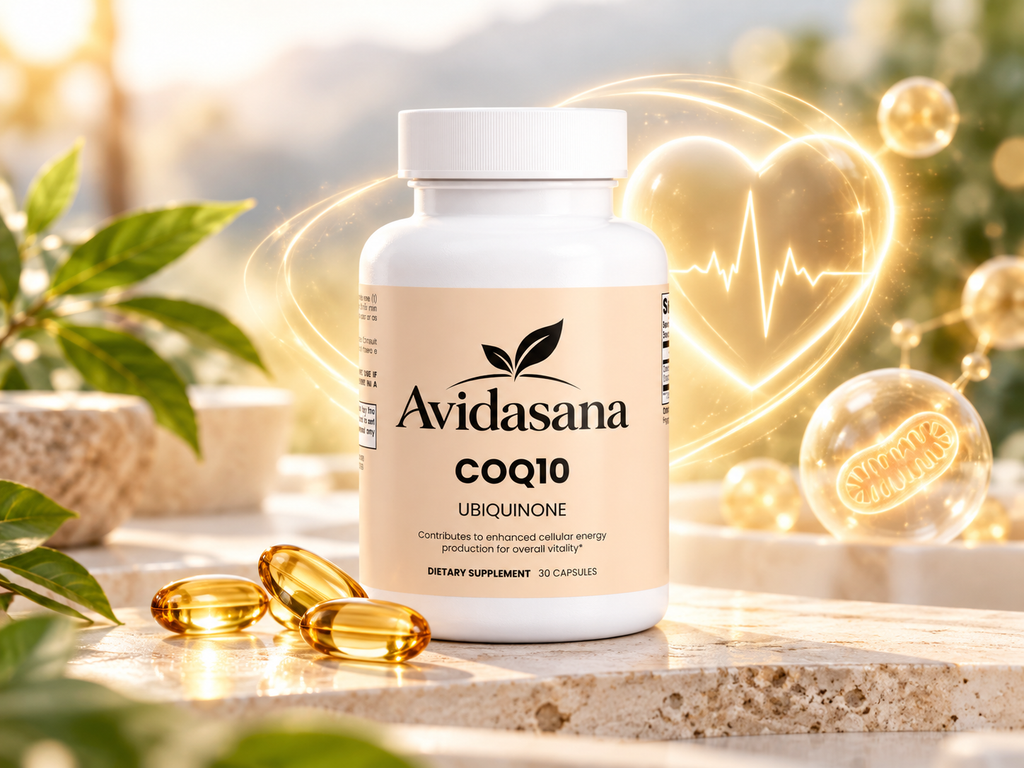
CoQ10 is one of those supplements that seems to show up everywhere.
You see it on shelves marketed for energy.
You hear people talk about it for heart health.
You may hear it mentioned alongside statin medications.
And because the name sounds highly scientific, it can be difficult to know what is established fact, what is promising research, and what is simply clever marketing.
So let us simplify it.
Coenzyme Q10, usually called CoQ10, is a substance that your body naturally produces. It is present throughout the body, with especially high levels found in organs that use a great deal of energy, including the heart, liver, kidneys, and pancreas.
That alone makes CoQ10 interesting.
But interesting is not the same as miraculous.
And that distinction matters.
What Does CoQ10 Actually Do?
Your cells need energy to function.
Inside your cells are tiny structures called mitochondria. You can think of mitochondria as little power plants.
CoQ10 participates in the process these power plants use to create cellular energy.
It also functions as an antioxidant.
Antioxidants help protect cells from damage associated with unstable molecules often referred to as free radicals.
So CoQ10 is not some exotic substance invented in a laboratory.
Your body already uses it every day.
The real question is whether taking extra CoQ10 as a supplement provides meaningful benefits.
That is where things become more complicated.
Why Do People Take CoQ10?
People commonly use CoQ10 supplements for several reasons.
Some take it because they want general energy support.
Some take it because they are interested in cardiovascular health.
Others take it because they are using cholesterol lowering medications known as statins and have heard that statins may affect CoQ10 levels.
There has also been research involving CoQ10 in heart failure, blood pressure, Parkinson’s disease, fertility, migraine, and other conditions.
But the evidence is not equally strong in all of these areas.
The National Center for Complementary and Integrative Health notes that CoQ10 has been studied extensively, but research results vary depending on the condition being studied.
That is a good reminder whenever we discuss supplements.
One substance does not automatically produce the same result for every health problem.
CoQ10 and Heart Health
The connection between CoQ10 and the heart makes biological sense.
The heart is constantly working.
That means heart muscle cells need enormous amounts of energy.
Because CoQ10 plays a role in cellular energy production, researchers have spent years studying whether supplementation might help people with certain cardiovascular conditions.
Some studies involving heart failure have reported benefits.
A recent review described evidence suggesting possible improvements in functional capacity and some heart failure outcomes, although this is not the same as saying CoQ10 should replace proven cardiovascular treatments.
The National Center for Complementary and Integrative Health takes a more cautious position, noting that research involving heart failure and heart disease remains inconclusive overall.
That difference in wording is important.
Researchers may see promising signals.
Public health agencies typically wait for stronger, more consistent evidence before making broad recommendations.
For consumers, the sensible takeaway is simple.
CoQ10 is being studied seriously.
But it should not be viewed as a replacement for medications, lifestyle changes, or medical care prescribed for heart disease.
The Statin Question
This is probably one of the most common reasons people become interested in CoQ10.
Statins are widely prescribed because they are highly effective at lowering LDL cholesterol and reducing cardiovascular risk.
But some people taking statins report muscle soreness, weakness, cramps, or fatigue.
You may have heard the theory that statins lower CoQ10 levels and that supplementation might therefore reduce these muscle symptoms.
It is a reasonable hypothesis.
The problem is that the research has not been consistent.
Some studies suggest benefit.
Others do not.
A 2025 systematic review and meta analysis involving seven randomized controlled trials found a modest overall reduction in statin associated muscle pain among people taking CoQ10. The authors also emphasized that more research is needed before firm recommendations can be made.
Earlier research has sometimes reached different conclusions.
A 2021 meta analysis found no statistically significant benefit for muscle pain.
Another clinical analysis found that CoQ10 users did not experience significant improvement in statin associated muscle symptoms compared with nonusers.
So what does that mean?
It means the science is still unsettled.
CoQ10 may help some people.
But it is not accurate to say that it has been proven to prevent or eliminate statin muscle symptoms.
If you experience muscle problems while taking a statin, do not simply stop the medication.
Talk to the clinician who prescribed it.
There may be several possible causes and several possible solutions.
CoQ10 and Energy
Because CoQ10 is involved in mitochondrial energy production, it is easy to understand why supplements are often marketed as energy boosters.
But biology and advertising are not always the same thing.
Your body requires CoQ10 to produce energy at the cellular level.
That does not automatically mean that taking more CoQ10 will make a healthy person feel more energetic.
This is a common mistake in supplement marketing.
A nutrient can be essential to a biological process without higher amounts necessarily producing a larger effect.
Think of gasoline in a car.
A car needs gasoline to run.
But once the tank is full, pouring gasoline over the hood does not make the engine more powerful.
The human body is more complicated than a car, but the principle is similar.
More is not automatically better.
Does CoQ10 Decline With Age?
CoQ10 levels may decline as we grow older.
That fact is one reason researchers have become interested in its possible role in healthy aging.
But aging is complicated.
Lower levels of a substance do not automatically mean that taking it as a supplement reverses aging or prevents age related disease.
This is an area where consumers should be especially skeptical of dramatic claims.
If someone tells you that a single supplement will restore youth, reverse aging, protect your heart, eliminate fatigue, and sharpen your brain all at once, your skepticism should probably arrive before your credit card.
Healthy aging remains remarkably unglamorous.
Exercise.
Good nutrition.
Adequate sleep.
Maintaining muscle.
Controlling blood pressure.
Not smoking.
Staying socially connected.
Receiving appropriate medical care.
Supplements may have a role.
But they belong inside the larger picture.
Ubiquinone and Ubiquinol
If you shop for CoQ10, you may encounter two names.
Ubiquinone.
And ubiquinol.
These are related forms of CoQ10.
Ubiquinone is the oxidized form, while ubiquinol is the reduced form.
The body can convert between them.
You may see claims that one form is always superior to the other.
The reality is more nuanced.
Absorption can depend on formulation, dose, the individual taking it, and whether it is taken with food.
Consumers should be cautious about paying dramatically more for a product based solely on marketing language suggesting that one form is universally superior.
How Should CoQ10 Be Taken?
CoQ10 is fat soluble.
That means taking it with a meal containing some dietary fat may improve absorption.
Many commercially available products come in softgel form for this reason.
Dosages vary widely depending on the product and the reason someone is taking it.
There is no single dose that is appropriate for everyone.
This is another reason to avoid assuming that if a little is good, more must be better.
Supplement decisions should take into account your health history, medications, and what you are actually trying to accomplish.
Is CoQ10 Safe?
CoQ10 is generally considered well tolerated.
The National Center for Complementary and Integrative Health reports that serious side effects have not commonly been reported, although some people may experience mild problems such as digestive upset or insomnia.
But there is an important word in that sentence:
Generally.
Supplements can interact with medications.
CoQ10 may interact with warfarin, a blood thinning medication.
It may also interact with insulin and may not be compatible with certain cancer treatments.
That is why it is wise to tell your physician, pharmacist, or other qualified healthcare professional about every supplement you take.
Many people do not mention supplements because they do not consider them medications.
But your body does not care whether something came from a pharmacy counter or a health food store.
Biologically active substances can interact.
Supplements Are Not Substitutes
This point deserves emphasis.
A supplement is not a substitute for proven medical care.
If your doctor prescribed a statin because you have elevated cardiovascular risk, do not replace it with CoQ10 because you read an article online.
If you have heart failure, do not replace prescribed medications with a supplement.
If you are experiencing unexplained fatigue, do not assume you simply need CoQ10.
Fatigue can have dozens of causes.
The goal of responsible supplementation should be to support health, not to avoid appropriate medical evaluation.
What Should You Look for in a CoQ10 Product?
When choosing any supplement, simplicity is often useful.
Look at the label.
Know the amount of CoQ10 in each serving.
Pay attention to serving size.
Check other ingredients.
Avoid assuming that a longer ingredient list automatically means a better product.
And remember that quality matters.
Dietary supplements are regulated differently from prescription medicines, which makes buying from reputable manufacturers particularly important.
If you are interested in adding CoQ10 to your supplement routine, you can review the A Vida Sana CoQ10 product here.
Who Might Want to Discuss CoQ10 With Their Doctor?
It may be worth asking your healthcare professional about CoQ10 if:
You are taking a statin and experiencing muscle symptoms.
You have a cardiovascular condition and are curious about complementary approaches.
You already take multiple medications and want to make sure there are no interactions.
You are using warfarin or insulin.
You are receiving cancer treatment.
Or you simply want to understand whether supplementation makes sense for your particular health goals.
The key words are:
For your particular situation.
Personal health decisions should be personal.
The Bigger Lesson About Supplements
CoQ10 is a good example of how we should think about nutritional supplements in general.
Avoid two extremes.
The first extreme says:
Supplements are useless.
That is too simplistic.
The second says:
Supplements can fix everything.
That is equally simplistic.
The more realistic position lies somewhere in the middle.
Some supplements may be useful for certain people under certain circumstances.
Others may provide little benefit.
Some may interact with medications.
And the quality of evidence varies enormously from one supplement to another.
That is why education matters.
The Bottom Line
CoQ10 is a naturally occurring substance involved in cellular energy production and antioxidant activity.
It has attracted legitimate scientific interest, particularly in cardiovascular medicine and in people experiencing statin associated muscle symptoms.
But the evidence is not definitive.
Some studies suggest benefit.
Others do not.
That means CoQ10 should be approached the same way we should approach most health supplements.
With curiosity.
With realistic expectations.
And with a healthy dose of skepticism.
If CoQ10 fits into your health and wellness plan, you can learn more about A Vida Sana CoQ10.
And if you take prescription medications or have an ongoing medical condition, discuss supplements with your healthcare professional before adding something new.
Because the smartest supplement decision is not the one with the biggest promise.
It is the one made with the best information.
