Skincare has become complicated.
Very complicated.
You can now buy serums with ingredients that sound like they were invented in a chemistry laboratory, creams with twelve-step application instructions, and products that somehow require a small mortgage payment.
And then there is shea butter.
Simple.
Natural.
Rich.
Used for generations.
And still one of the most practical ingredients for dry skin.
If your skin feels rough, tight, flaky or simply less comfortable than it used to, raw shea butter may be worth considering as part of a simple moisturizing routine.
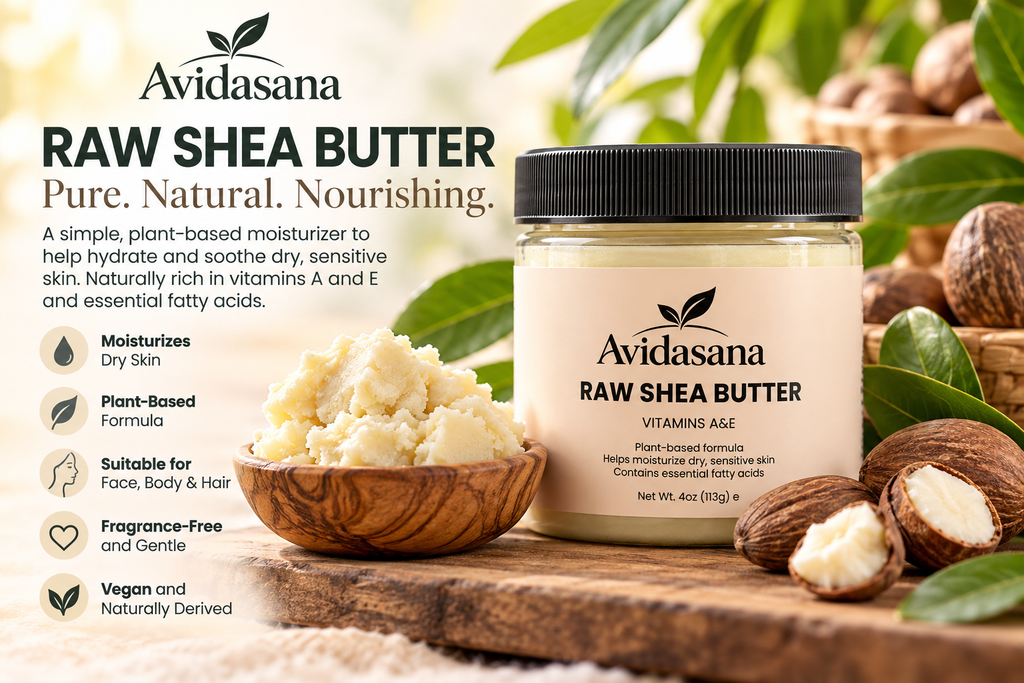
At Avidasana, our Raw Shea Butter contains one ingredient: raw organic shea butter. It is unrefined, fragrance-free, vegan and intended for use on the skin, body and hair.
Sometimes simple really is enough.
What Is Shea Butter?
Shea butter is a plant-based fat derived from the nut of the African shea tree, Vitellaria paradoxa.
At room temperature, shea butter is generally solid or semi-solid. But when you rub it between your hands, body heat softens it into a rich, spreadable moisturizer.
That texture is part of what makes it useful.
Rather than disappearing immediately like a lightweight lotion, shea butter forms a moisturizing layer over the skin.
Cleveland Clinic describes shea butter as an emollient that can help reduce moisture loss from the skin and notes that its fatty acids can help lubricate and soften dry skin.
In other words, shea butter doesn’t need a fancy advertising campaign to explain what it does.
It helps dry skin hold onto moisture.
Why Does Skin Become Drier With Age?
Dry skin can happen at any age.
Cold weather can do it.
Hot showers can do it.
Harsh soaps can do it.
Indoor heating can do it.
But aging can make the problem more noticeable.
As we get older, the skin may produce less natural oil and become less efficient at retaining moisture.
That is why skin that tolerated practically anything at age 25 can suddenly become demanding later in life.
Your skin basically starts sending invoices.
Dryness can show up almost anywhere, but it is especially common on the:
- Hands
- Elbows
- Knees
- Feet
- Legs
- Arms
- Face
A rich emollient such as shea butter can be especially useful for those areas because it creates a protective layer that reduces moisture loss.
What Makes Raw Shea Butter Different?
Shea butter is available in both refined and unrefined forms.
Refining can make shea butter more uniform in color and scent, but processing may also remove some naturally occurring components.
Cleveland Clinic notes that raw shea butter generally retains more of its natural constituents than heavily processed varieties.
Avidasana’s Raw Shea Butter is unrefined and contains no added fragrance. The product page lists the ingredient simply as:
Raw Organic Shea Butter.
That’s refreshingly uncomplicated.
If you are trying to simplify your skincare routine, an ingredient list you can read without a magnifying glass is not a bad place to start.
The Fatty Acids Matter
One reason shea butter works well as a moisturizer is its naturally occurring fatty-acid content.
These lipids help soften the skin and support the outer skin barrier.
That barrier matters.
Think of your skin barrier as the roof on your house.
Its job is partly to keep useful things in and unwanted things out.
When the barrier becomes dry or compromised, water escapes more easily.
The result?
Dryness.
Rough texture.
Tightness.
Flaking.
Shea butter can help by acting as an emollient and occlusive-type moisturizer, creating a layer that slows moisture loss.
A scientific review of plant butters and oils used on the skin found that their effects depend heavily on fatty-acid composition and skin condition. The authors emphasized that different oils and butters can interact differently with healthy and inflamed skin.
That is a useful reminder that “natural” does not automatically mean “perfect for everybody.”
Raw Shea Butter for Very Dry Areas
Some parts of the body seem to have declared war on moisturizer.
Heels are a good example.
Elbows are another.
Hands can become painfully dry, especially if you wash them frequently.
This is where the dense texture of raw shea butter can be particularly useful.
Try applying a small amount to slightly damp skin after bathing.
Why damp skin?
Because moisturizers are generally more effective when they help seal in water already present on the surface.
For very dry heels or hands, many people like applying a thicker layer before bed.
You can even cover the area with cotton socks or gloves overnight.
It is not glamorous.
But neither are cracked heels.
What About Shea Butter on the Face?
Shea butter can be used on the face, and Avidasana lists the product as suitable for face and body use.
However, this is one area where more isn’t necessarily better.
Shea butter is rich.
Very rich.
If you have dry or mature skin, that richness may feel wonderful.
If you have oily or acne-prone skin, it may be too heavy.
Cleveland Clinic cautions that shea butter may clog pores for some people with acne-prone skin.
So if you are using it on your face for the first time, start small.
Try a tiny amount on a limited area.
See how your skin responds.
Skincare should not require courage.
What About Sensitive Skin?
Avidasana’s Raw Shea Butter contains no added fragrance, which can be helpful for people who prefer to minimize fragrance exposure in skincare products.
Still, sensitive skin is unpredictable.
Someone can react to almost anything.
The safest approach with any new skincare product is to perform a patch test first.
Apply a small amount to a limited area and observe the skin before using it extensively.
If redness, burning, itching or irritation develops, stop using it.
The product instructions likewise recommend discontinuing use if irritation occurs.
Shea Butter for Hair
Shea butter isn’t limited to the skin.
It can also be used sparingly on dry hair.
This is particularly useful for:
- Dry ends
- Coarse hair
- Curly hair
- Frizz
- Hair exposed to dry weather
The key word is sparingly.
Shea butter is not shy.
Use too much and your hair may look as if you polished it.
Warm a tiny amount between your palms and work it lightly through dry areas.
Avidasana specifically lists hair as one of the intended uses of its Raw Shea Butter.
Does Shea Butter Contain Vitamins?
Shea butter naturally contains compounds associated with vitamins A and E, along with other plant constituents.
Cleveland Clinic notes that shea butter contains antioxidant compounds, including vitamin E-related components.
This does not mean shea butter should be marketed as some miracle anti-aging treatment.
That is where skincare advertising often gets ahead of the science.
There is a big difference between saying an ingredient contains antioxidants and claiming that it can reverse aging.
The first is reasonable.
The second belongs next to ads for miracle hair restorers and machines that promise you abs while watching television.
What raw shea butter does very well is much simpler:
It moisturizes and softens dry skin.
And frankly, that is useful enough.
Can Shea Butter Treat Eczema or Other Skin Diseases?
This is where we need to be careful.
Shea butter has a long history of traditional use for many skin conditions, particularly in parts of Africa.
A review published in the dermatology literature identified numerous traditional uses of shea butter for skin problems. However, the authors also noted that more research is needed.
A broader systematic review of complementary approaches to conditions such as eczema, acne and psoriasis found that the evidence is not strong enough to recommend these treatments as replacements for established medical therapy.
That distinction matters.
Shea butter can be an excellent moisturizer.
But if you have eczema, psoriasis, infected skin, persistent inflammation or another medical condition, talk with a healthcare professional rather than assuming a cosmetic moisturizer will treat the underlying disease.
Shea Butter Is Not Sunscreen
Here’s another place where marketing can get silly.
Shea butter may offer a very small amount of natural UV protection, but nowhere near enough to replace sunscreen.
Cleveland Clinic notes that its natural SPF is only around 3 to 4.
That is not meaningful sun protection for everyday outdoor exposure.
So use shea butter for moisture.
Use an appropriate sunscreen for sun protection.
Let each product do its own job.
How to Use Raw Shea Butter
A little goes a long way.
Start with a small amount.
Warm it between your fingers or palms until it softens.
Then gently massage it into the desired area.
Avidasana recommends applying a thin layer to the skin or hair where extra moisture is needed, with suggested use up to twice daily.
A simple routine might look like this:
After your shower, lightly pat the skin dry.
Leave it slightly damp.
Warm a small amount of shea butter between your hands.
Massage it into dry areas.
Pay extra attention to hands, elbows, knees, feet and legs.
Use more only if needed.
You do not have to coat yourself like a Thanksgiving turkey.
When Simple Skincare Makes Sense
There is an interesting trend happening in skincare.
After years of complicated routines, many people are starting to simplify.
Fewer products.
Fewer ingredients.
Less fragrance.
Less experimentation.
More attention to the basics:
Cleanse gently.
Moisturize.
Protect from the sun.
Be consistent.
That philosophy fits naturally with raw shea butter.
If you are interested in keeping your routine simple, you can explore Avidasana skincare and wellness products and choose products based on what your skin actually needs rather than how many bottles can fit on your bathroom counter.
If hydration is your main concern, you may also want to explore Avidasana’s Skin Hydration product as part of a broader approach to skin wellness.
Topical skincare and overall wellness are not competing ideas.
They can complement each other.
A Note About Expectations
This may be the most important part of the article.
Skincare products do not have to perform miracles to be valuable.
You don’t need a moisturizer to make you look twenty years younger.
You need it to help your skin feel comfortable.
Soft.
Flexible.
Less dry.
Less rough.
That is a perfectly worthwhile objective.
Raw shea butter has survived generations of skincare trends because it does something fundamental very well:
It moisturizes.
Sometimes the old solutions survive because they work.
The Bottom Line
Raw shea butter is not a miracle cure.
And that is actually one of the reasons we like it.
It doesn’t need to be.
It is a rich, plant-based moisturizer that can help soften dry skin and reduce moisture loss.
Avidasana Raw Shea Butter is made from a single ingredient—raw organic shea butter—and is unrefined, fragrance-free, vegan and suitable for use on the skin and hair.
For dry hands, feet, elbows, legs or other rough areas, that simplicity can be exactly what you need.
Start with a small amount.
Use it consistently.
Pay attention to how your skin responds.
And remember:
Healthy skincare does not have to be complicated.
Sometimes it can come down to one good ingredient.
Raw organic shea butter.
Explore Raw Shea Butter at Avidasana and discover a simpler approach to everyday skin moisture.
