Walk through the skin-care aisle today and you would think aging had become a medical emergency.
“Erase wrinkles.”
“Reverse aging.”
“Look ten years younger.”
“Turn back the clock.”
Apparently, all we need is a tiny jar and a credit card.
If only it were that easy.
The truth about aging skin is less dramatic, but much more useful.
No moisturizer can make a 70-year-old face biologically 40 again.
No cream can give you a facelift.
And no respectable company should promise that it can.
But that does not mean moisturizer is useless.
In fact, dermatologists consider moisturizer one of the most practical and effective parts of an anti-aging skin-care routine. The American Academy of Dermatology says sunscreen and moisturizer are two of the most effective anti-aging products people can use.
And moisturizer can become even more important as we grow older.
So let’s talk about what actually happens to our skin after 60, what moisturizer can realistically accomplish, and why something simple may sometimes be more useful than the latest miracle serum.
Why Does Skin Become Drier as We Age?
Skin changes throughout life.
By our 60s and 70s, many of us notice that it feels different.
It may become:
Drier.
Thinner.
More fragile.
More easily irritated.
Less elastic.
More prone to itching.
More likely to show fine lines and wrinkles.
The National Institute on Aging explains that aging skin becomes thinner and less elastic, while oil and sweat glands may become less active. Collagen and elastin also change with age, contributing to wrinkles and reduced firmness.
In other words, your skin isn’t simply getting older because the calendar says so.
Its structure is changing.
And one particularly important change is its ability to hold moisture.
Younger skin generally does a better job of maintaining its protective barrier.
As we age, water escapes from the skin more easily.
That can leave skin feeling dry, rough or tight.
And dry skin tends to make fine lines more noticeable.
That’s one reason a good moisturizer can make a surprisingly visible difference.
It isn’t removing the wrinkles.
It’s helping the skin retain water.
Moisturizer Does Something Very Simple
Sometimes we make skin care sound much more complicated than it needs to be.
A moisturizer primarily helps do two things:
Add moisture to the skin.
And:
Reduce the amount of water escaping from the skin.
The American Academy of Dermatology explains that creams and ointments can help trap water in the skin, soften it and improve the skin barrier.
That can make skin feel:
Softer.
Smoother.
More comfortable.
Less tight.
And temporarily more plump.
That last point is important.
When skin is better hydrated, fine lines can appear less noticeable.
That is one of the legitimate reasons moisturizer is often described as “anti-aging.”
It doesn’t remove ten years from your birth certificate.
It improves the appearance and condition of the skin you have.
That’s a much more sensible goal.
After 50, Creams May Make More Sense
One interesting recommendation from dermatologists is that skin-care needs can change with age.
The American Academy of Dermatology notes that skin tends to hold less moisture as we grow older and says adults over 50 often benefit from cream-based moisturizers rather than lighter formulations.
Why?
Because creams generally contain more oil than lightweight lotions or gels.
That helps them create a stronger barrier against water loss.
If your skin becomes increasingly dry after 60, the moisturizer you loved at 35 may simply not be enough anymore.
Your skin changed.
Your skin care may have to adapt with it.
There is nothing unusual about that.
We don’t wear the same prescription glasses for 30 years.
Our skin shouldn’t necessarily use the same products either.
What About Wrinkles?
This is where advertising gets carried away.
Moisturizers can improve the appearance of fine lines by increasing hydration.
The American Academy of Dermatology specifically notes that moisturizer can trap water in the skin, making some fine lines appear less noticeable.
But moisturizer cannot erase deep wrinkles.
It cannot restore all the collagen that has been lost over decades.
It cannot undo every bit of sun damage accumulated since 1968.
Unfortunately, the skin remembers those summers at the beach even if we don’t.
And this is why expectations matter.
A good moisturizer should be judged by reasonable questions:
Does my skin feel less dry?
Does it feel smoother?
Does it look more hydrated?
Does my face feel comfortable rather than tight?
Does my skin look healthier?
Those are realistic goals.
“Will I look 25 again by Thursday?”
Probably not.
And if the label promises that, keep walking.
The Sun May Be Aging Your Skin More Than You Think
If moisturizer is one side of an intelligent anti-aging routine, sun protection is the other.
Possibly the more important one.
Ultraviolet radiation damages skin cells over time.
That cumulative sun exposure contributes to:
Wrinkles.
Uneven pigmentation.
Age spots.
Changes in texture.
Loss of elasticity.
And, much more importantly, skin cancer.
The National Institute on Aging identifies ultraviolet exposure as a major contributor to premature skin aging.
The American Academy of Dermatology recommends broad-spectrum, water-resistant sunscreen with an SPF of at least 30 for exposed skin.
Here’s the funny part.
People will spend $100 on an “age reversing” cream…
and then walk outside without sunscreen.
That’s a little like buying expensive floor polish while leaving the roof open during a rainstorm.
Protect what you’re trying to preserve.
When Should You Apply Moisturizer?
Timing can make a difference.
One of the simplest tricks is to moisturize while your skin is still slightly damp.
After washing your face or getting out of the shower, gently pat your skin dry rather than rubbing it completely dry.
Then apply moisturizer.
The American Academy of Dermatology recommends applying moisturizer soon after bathing because it helps trap some of that moisture in the skin.
This is simple.
It costs nothing extra.
And it may help the moisturizer work more effectively.
Hot Showers Are Not Doing Your Skin Any Favors
I know.
A long hot shower feels good.
Especially on a cold morning.
Your skin may disagree.
Very hot water can strip away natural oils from the skin and make dryness worse.
Dermatologists recommend warm rather than hot water and shorter showers or baths, particularly for older adults who struggle with dry skin.
So if you get out of the shower looking like a boiled lobster…
we may have identified part of the problem.
Warm water.
Gentle cleansing.
Then moisturizer.
Sometimes healthy skin care is remarkably unexciting.
More Is Not Always Better
Another common mistake is putting five or six anti-aging products on the face at the same time.
Retinol.
Serum.
Acid.
Peel.
Vitamin C.
Exfoliator.
Moisturizer.
Then something that came in a tiny gold bottle costing more than dinner.
The American Academy of Dermatology warns that using multiple anti-aging products at once can irritate the skin. Irritated skin can actually make signs of aging look more noticeable.
Especially as skin becomes thinner and more sensitive with age, simpler may sometimes be better.
A gentle cleanser.
A moisturizer that agrees with your skin.
Sunscreen.
Then add other products only if you have a specific reason.
Your bathroom counter does not need to look like a chemistry laboratory.
How Long Should a Moisturizer Take to Work?
Hydration can improve the appearance of skin relatively quickly.
The American Academy of Dermatology notes that moisturizer may plump fine lines within several days, although many anti-aging products require six weeks or longer before their full effect becomes apparent.
Consistency matters.
Using moisturizer once every two weeks probably isn’t going to accomplish much.
Skin care is much like exercise.
The miracle is usually not the product.
It’s doing something sensible repeatedly.
Where Does AvidaSana Anti Aging Moisturizer Fit?
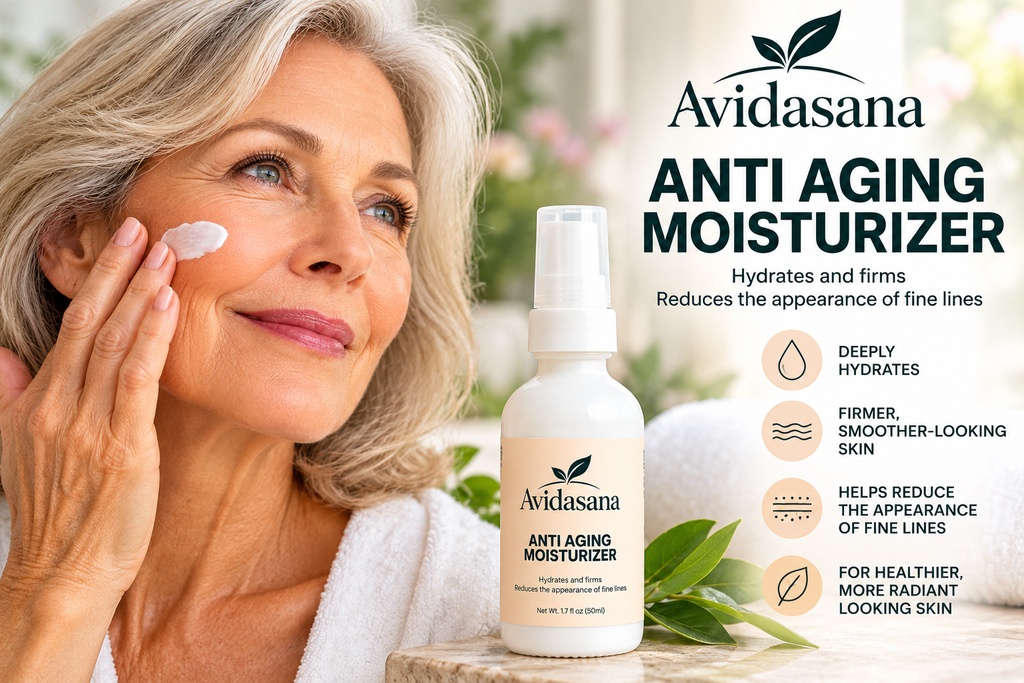
AvidaSana Anti Aging Moisturizer is part of our skin-care collection and is intended to support firmer, smoother-looking skin as part of a regular skin-care routine. The current AvidaSana product listing shows the moisturizer among our skin-care products.
We prefer to be very clear about what that means.
This is a cosmetic moisturizer.
It is not a medical treatment.
It is not a facelift in a jar.
It does not stop biological aging.
What a moisturizer can reasonably do is support hydration and help skin feel softer, smoother and more comfortable.
That is useful enough without exaggerating it.
You can view AvidaSana Anti Aging Moisturizer here:
AvidaSana.com/product/anti-aging-moisturizer/
Skin Care After 60 Is Really About Protecting the Barrier
You hear the phrase “skin barrier” constantly now.
It sounds technical.
It really isn’t.
Think of the outer layer of your skin as a brick wall.
The skin cells are the bricks.
The fats and other substances between them are the mortar.
When that protective barrier works well, water stays in and irritants stay out.
As we age, that barrier can become less efficient.
That contributes to dryness and sensitivity.
A moisturizer helps reinforce that barrier by reducing water loss and supporting the skin surface.
That’s why moisturizing is not simply cosmetic.
For someone with increasingly dry older skin, it can also improve comfort.
When Dry Skin Is More Than Dry Skin
One warning.
Not every dry or irritated patch of skin should simply be covered with moisturizer and forgotten.
See a healthcare professional or dermatologist if you notice:
A sore that doesn’t heal.
A rapidly changing mole.
Bleeding without an obvious cause.
A new persistent growth.
Severe itching.
Cracking or bleeding skin.
A rash that doesn’t improve.
An area that repeatedly scabs.
A spot that changes color, shape or size.
Skin cancer risk increases with age, which is one reason the American Academy of Dermatology recommends regularly checking the skin for changes.
Moisturizer is useful.
It is not a substitute for noticing when something isn’t right.
Don’t Forget the Rest of Your Skin
We tend to think “anti-aging” means the face.
Your arms didn’t get the memo.
Neither did your hands.
Or your neck.
Or your legs.
Older adults often experience dryness particularly on the lower legs, elbows and forearms. The National Institute on Aging recommends using moisturizers such as creams, lotions or ointments regularly to help manage dry skin.
Your hands deserve particular attention.
They are washed repeatedly.
Exposed to sunlight.
Exposed to cleaning products.
And often completely forgotten until they become cracked.
Again, moisturize.
Sometimes the obvious answer really is the answer.
Healthy Skin Also Comes From the Inside
A moisturizer works on the outside.
But skin is still living tissue.
Overall health matters.
Adequate nutrition.
Hydration.
Sleep.
Avoiding smoking.
Physical activity.
Sun protection.
Managing medical conditions.
All of those things contribute to how skin ages.
The National Institute on Aging notes that smoking, dehydration, excess sun exposure and other health factors can contribute to dry or aging skin.
No cream can compensate for everything happening inside your body.
That’s true of skin care just as it’s true of supplements.
Maybe “Anti-Aging” Is the Wrong Phrase
Here’s another way to think about it.
At AvidaSana, we’re not particularly interested in pretending people don’t age.
We do age.
Hopefully for a very long time.
The better goal isn’t to become young again.
It’s to take care of the body we have now.
That includes our skin.
Healthy skin at 70 doesn’t need to look like skin at 30.
It needs to be:
Comfortable.
Protected.
Hydrated.
Healthy-looking.
And cared for.
There is a difference between fighting age…
and taking care of yourself as you age.
We prefer the second one.
The Bottom Line
Does an anti-aging moisturizer reverse aging?
No.
Can a good moisturizer improve dry, aging skin?
Absolutely.
Moisturizing helps the skin retain water.
Better hydration can make skin feel softer and smoother.
It can temporarily reduce the appearance of some fine lines.
And as the skin becomes thinner and drier with age, regular moisturizing becomes increasingly useful.
But keep the bigger picture in mind.
Use sunscreen.
Avoid excessive sun exposure.
Use warm instead of very hot water.
Clean your skin gently.
Moisturize consistently.
Watch for unusual skin changes.
And don’t believe every miracle claim printed on a beautiful jar.
Sometimes taking good care of aging skin isn’t complicated.
It simply requires doing a few sensible things consistently.
And perhaps that’s the most useful definition of anti-aging there is.
Not turning back the clock.
Taking better care of the years you’re in.
AvidaSana Anti Aging Moisturizer
Designed as part of a simple skin-care routine to support firmer, smoother-looking skin.
Explore the product at AvidaSana.com/product/anti-aging-moisturizer/
AvidaSana
For Seniors, By a Senior.
This article is for educational purposes and is not a substitute for medical advice. Cosmetic products are not intended to diagnose, treat, cure or prevent disease. If you have persistent or unusual skin changes, speak with your healthcare professional or dermatologist.
