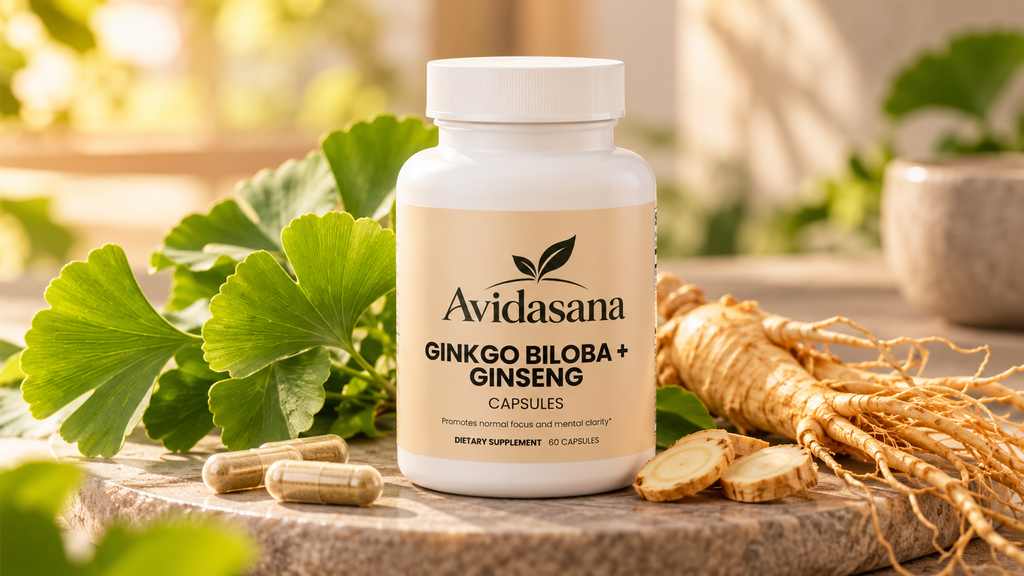
For centuries, people have turned to plants for help with energy, focus, resilience, and general well-being.
Two of the best-known traditional herbs are Ginkgo biloba and ginseng.
They are often found together in dietary supplements because each has a long history of traditional use and both have attracted scientific interest for their possible effects on mental performance, fatigue, circulation, and healthy aging.
But what does modern research actually say?
Can ginkgo improve memory?
Can ginseng increase energy?
Can the two together support concentration?
And just as importantly, what should older adults know about safety and medication interactions before taking them?
The answers are more nuanced than many supplement advertisements suggest.
What Is Ginkgo Biloba?
Ginkgo biloba comes from one of the oldest surviving tree species on Earth.
It is sometimes called a living fossil because relatives of the modern ginkgo tree existed millions of years ago.
Today, supplements generally use extracts made from ginkgo leaves.
Ginkgo has been promoted for many purposes, including memory, circulation, cognitive performance, tinnitus, anxiety, and age-related cognitive decline.
The National Center for Complementary and Integrative Health, or NCCIH, notes that ginkgo has been studied extensively. However, there is still no conclusive evidence that it prevents dementia or slows the development of Alzheimer’s disease.
That distinction is important.
There is a big difference between saying:
“Ginkgo is being studied for cognitive health.”
and saying:
“Ginkgo prevents dementia.”
The first statement is accurate.
The second is not supported by current evidence.
What Has Research Found About Ginkgo and Memory?
The largest long-term study of ginkgo in older adults was the Ginkgo Evaluation of Memory Study, commonly called the GEM study.
It included more than 3,000 adults age 75 and older.
Participants took either ginkgo extract or a placebo for several years.
Researchers found that ginkgo did not reduce the overall development of dementia or Alzheimer’s disease.
A newer 2026 Cochrane review reached a more nuanced conclusion.
In people with mild cognitive impairment, ginkgo appeared to provide little or no meaningful benefit.
In people already diagnosed with dementia, some studies suggested small to moderate improvements in areas such as cognition, daily functioning, or overall clinical status, but the certainty of the evidence was low and results varied considerably between studies.
So the current scientific picture looks something like this:
Ginkgo has not been shown to prevent dementia.
It has not been shown reliably to improve memory in healthy older adults.
But certain standardized ginkgo extracts may have modest effects in some people who already have cognitive impairment or dementia.
That is interesting research.
It is not a cure.
What Is Ginseng?
The word ginseng can refer to several plants.
One of the most studied is Asian ginseng, also known as Panax ginseng.
Ginseng root has been used for centuries in traditional Asian medicine.
It has traditionally been associated with vitality, stamina, resilience, and mental performance.
Today, ginseng is promoted for fatigue, stress, cognitive function, athletic performance, healthy aging, and general energy.
Scientists believe many of ginseng’s biological effects may be related to compounds called ginsenosides.
These substances are being studied for their effects on the nervous system, metabolism, inflammation, and other biological processes.
Can Ginseng Help With Energy or Fatigue?
This is one of the more interesting areas of ginseng research.
A review cited by NCCIH included 19 studies and more than 2,400 participants.
It suggested that Asian ginseng may have a small beneficial effect on general fatigue, although the evidence was not strong enough to consider ginseng a proven treatment for chronic fatigue conditions.
That means ginseng may be reasonable to study as a supplement for general vitality or fatigue, but it should not replace a medical evaluation.
Persistent fatigue can have many causes, including:
Anemia.
Thyroid problems.
Sleep apnea.
Medication side effects.
Heart disease.
Diabetes.
Depression.
Vitamin deficiencies.
Poor sleep.
And many other medical conditions.
If fatigue is new, severe, or persistent, the first step should be figuring out why it is happening.
What About Ginseng and Mental Performance?
Research into ginseng and cognition is also interesting but incomplete.
NCCIH notes that a small amount of research suggests Asian ginseng may improve certain measures of cognitive performance in middle-aged adults, including attention, reaction time, abstract thinking, and arithmetic skills.
However, most studies have been relatively small and short.
That means scientists still do not know how meaningful these effects are in everyday life.
Researchers also need larger and longer studies before drawing strong conclusions.
This is a recurring theme in supplement research.
The early studies may look promising.
But promising is not the same thing as proven.
Why Are Ginkgo and Ginseng Often Combined?
The combination makes sense from a traditional and practical standpoint.
Ginkgo is often associated with cognitive health and circulation.
Ginseng is traditionally associated with energy, stamina, and resilience.
Together, they are commonly marketed as a combination for people who want support for:
Mental alertness.
Concentration.
Daily energy.
Focus.
General vitality.
Healthy aging.
There has been some limited research suggesting that cognitive effects associated with ginseng may be influenced by the addition of ginkgo, but the evidence remains too limited to promise a predictable benefit.
For consumers, the reasonable approach is to view the combination as a dietary supplement intended to support general wellness, not as a treatment for dementia, Alzheimer’s disease, chronic fatigue, or any other medical condition.
Brain Health Is Bigger Than Any Supplement
When people think about keeping their brains healthy, supplements often get most of the attention.
But the strongest evidence for healthy aging generally points toward everyday habits.
Physical activity matters.
Blood pressure control matters.
Sleep matters.
Hearing matters.
Social interaction matters.
Managing diabetes matters.
Avoiding smoking matters.
Maintaining muscle matters.
And continuing to use the brain matters.
Learning something new.
Reading.
Having conversations.
Solving problems.
Traveling.
Joining groups.
Using technology.
Taking up hobbies.
All of these activities help keep us engaged with the world.
No supplement should be viewed as a substitute for those fundamentals.
Can Ginkgo Improve Circulation?
Ginkgo has long been associated with circulation.
Laboratory research suggests that ginkgo extracts can influence blood vessels, platelets, and blood flow.
But clinical outcomes are less straightforward.
For example, research has not shown that ginkgo reliably prevents cardiovascular disease or lowers blood pressure.
So it is reasonable to say that ginkgo has biological effects related to circulation.
It would not be reasonable to describe it as a treatment for heart disease or high blood pressure.
This is another area where careful wording matters.
Safety Matters, Especially for Older Adults
“Natural” does not automatically mean “risk free.”
This becomes increasingly important as we get older because many seniors take several prescription medications.
Ginkgo can cause side effects such as:
Headache.
Dizziness.
Digestive upset.
Nausea.
Diarrhea.
Allergic skin reactions.
One of the biggest concerns is bleeding risk.
NCCIH specifically warns that ginkgo may increase the risk of bleeding when combined with anticoagulant medications such as warfarin.
People taking blood thinners or antiplatelet medications should talk with their doctor or pharmacist before using ginkgo.
That may include medications such as:
Warfarin.
Apixaban.
Rivaroxaban.
Clopidogrel.
And, depending on the situation, aspirin.
Someone scheduled for surgery should also tell the surgical team about all supplements they are taking.
Ginseng Can Interact With Medications Too
Asian ginseng also deserves caution.
Researchers continue to investigate possible interactions involving blood-pressure medications, statins, antidepressants, and warfarin.
That does not mean everyone taking those medications must avoid ginseng.
It means the combination should be reviewed.
This is especially important for older adults taking several medications at once.
A pharmacist can often be one of the best people to ask about supplement-drug interactions.
Bring the supplement bottle or ingredient list with you.
Let the pharmacist see exactly what you are taking.
Dietary Supplements Are Not Tested Like Prescription Drugs
This is another important point.
Dietary supplements are regulated differently from prescription medications.
The product you purchase in a store or online may not be identical to the standardized extract used in a clinical study.
NCCIH specifically cautions that commercial supplements can differ from research products in formulation and quality.
That is one reason consumers should pay attention to:
The ingredient list.
Serving size.
Dosage.
Manufacturer reputation.
Third-party testing when available.
And whether the label makes exaggerated medical claims.
Be skeptical of phrases such as:
“Prevents Alzheimer’s.”
“Reverses dementia.”
“Restores memory.”
“Guaranteed brain enhancement.”
Those claims go far beyond what the evidence supports.
A Better Way to Think About Supplements
A dietary supplement does not have to cure a disease to have a place in someone’s wellness routine.
The better question is:
Does this supplement fit into an overall plan for healthy living, and is it safe for me personally?
For someone interested in ginkgo and ginseng, that may mean looking at the product as one small part of a larger approach that includes:
Regular exercise.
Adequate sleep.
Nutritious food.
Stress management.
Social connection.
Medical care.
Mental activity.
And appropriate management of chronic conditions.
That is a much more realistic view than expecting one capsule to compensate for everything else.
Who Should Talk With a Healthcare Professional First?
It is particularly important to check with a doctor or pharmacist if you:
Take blood thinners.
Take several prescription medications.
Have a bleeding disorder.
Are preparing for surgery.
Have diabetes.
Take blood-pressure medications.
Take antidepressants.
Are pregnant or breastfeeding.
Or have a serious chronic medical condition.
This does not mean dietary supplements are inherently dangerous.
It means that supplements contain biologically active substances.
And substances that affect the body can sometimes interact with other substances that affect the body.
The Bottom Line
Ginkgo biloba and ginseng are two of the world’s best-known traditional herbal ingredients.
Both have long histories of use.
Both remain active areas of scientific research.
Ginseng may offer modest support for general fatigue and certain aspects of cognitive performance in some adults, although stronger research is still needed.
Ginkgo has been studied extensively for cognitive health. Large trials have found that it does not prevent dementia or Alzheimer’s disease, although some research suggests certain standardized extracts may produce modest benefits in people who already have dementia.
The smartest approach is neither to dismiss traditional herbs automatically nor to treat them as miracle cures.
Look at the evidence.
Understand the limitations.
Check for medication interactions.
And remember that supplements work best as part of a broader healthy lifestyle.
Healthy aging is rarely about one ingredient.
It is about what we do consistently.
How we move.
How we sleep.
How we eat.
How we manage our health.
How we stay connected.
And how we continue to participate in life.
That is the bigger picture.
And when it comes to healthy aging, the bigger picture usually matters most.
