Your digestive system is home to trillions of microorganisms.
That may not sound especially comforting at first.
Most of us grew up hearing that bacteria were something to wash off, disinfect, or avoid.
But modern research has changed that picture dramatically.
Many of the microorganisms living in the digestive tract are part of what scientists call the gut microbiome, and some of them play useful roles in digestion, metabolism, and normal immune function.
That is one reason probiotics have become such a popular topic.
But probiotics are also widely misunderstood.
They are not magic.
They are not all the same.
And a bottle with an enormous number printed on the label is not automatically better than every other option.
So what exactly are probiotics, what does “20 billion CFU” mean, and how should you think about adding a probiotic supplement to your wellness routine?
Let’s take a closer look.
What Are Probiotics?
Probiotics are live microorganisms, usually bacteria or yeasts, that may provide health benefits when consumed in adequate amounts.
The National Institutes of Health explains that probiotics are found naturally in some fermented foods, are added to certain foods, and are also available as dietary supplements. They act primarily in the digestive tract, where they can interact with the gut microbiome.
Some of the best-known probiotic groups include:
Lactobacillus
Bifidobacterium
and certain beneficial yeasts.
But there is an important detail many consumers miss:
The word probiotic does not describe one single thing.
Different species and different strains can behave differently in the body.
That is why scientists increasingly emphasize the importance of looking at the actual organisms in a probiotic rather than treating all probiotics as interchangeable.
What Does “20 Billion CFU” Mean?
When you look at a probiotic label, you will often see a number followed by the letters CFU.
CFU stands for colony-forming units.
In simple terms, it is a way of estimating the number of viable microorganisms in the product.
So when a supplement is described as containing 20 billion CFU, that indicates the product is formulated to provide a large number of live microorganisms.
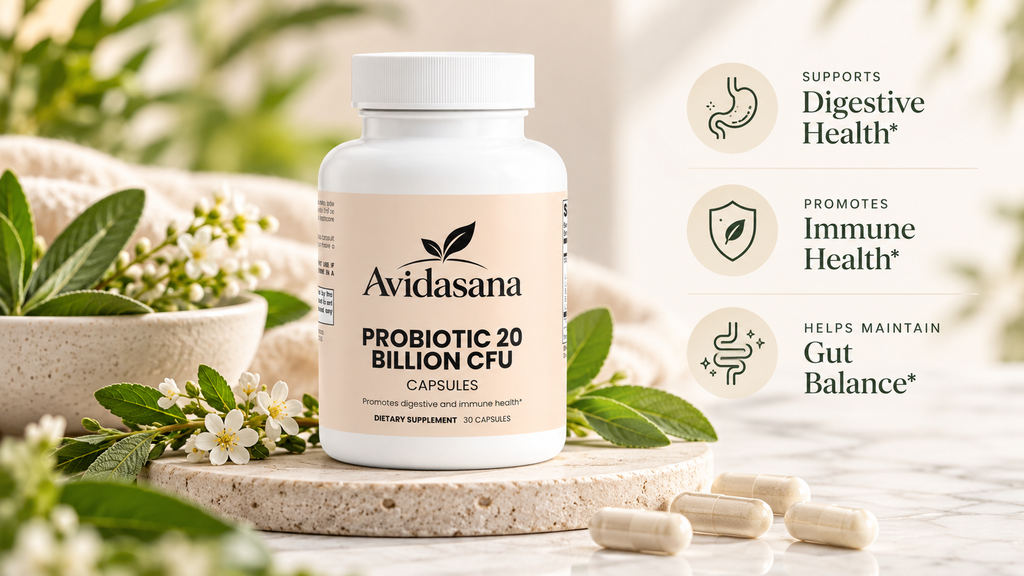
A Vida Sana offers a Probiotic 20 Billion CFU supplement for people interested in adding probiotic support to their daily wellness routine.
You can view the product here:
A Vida Sana Probiotic 20 Billion CFU
But here is something important to understand.
More CFUs do not automatically mean a better probiotic.
The type of organisms, the specific strains, product quality, storage conditions, and whether the supplement matches the person’s needs can all matter.
In other words, this is not a competition where the biggest number on the bottle automatically wins.
Your Gut Is an Ecosystem
One of the easiest ways to understand the microbiome is to imagine a garden.
A healthy garden contains many different organisms interacting with each other.
Some help maintain balance.
Some compete with one another.
And the environment itself determines what grows well.
Your digestive tract is much more complicated than a garden, of course, but the comparison helps explain why scientists are so interested in microbial balance.
The gut microbiome can be influenced by many factors, including:
Diet
Age
Medications
Illness
Stress
Environment
And antibiotic use.
This also explains why there may not be one perfect probiotic for everyone.
Each person’s gut microbiome is different.
Probiotics and Digestion
Most people become interested in probiotics because of digestive health.
The NIH notes that probiotics act mainly in the digestive tract and may influence digestive function and the intestinal microbiome.
Researchers have studied probiotics in connection with a wide range of digestive issues.
Some evidence suggests certain probiotic preparations may be useful in specific situations, including some forms of antibiotic-associated diarrhea.
However, the National Center for Complementary and Integrative Health also emphasizes that researchers still do not know which probiotics work best for many conditions, how much should be taken, or who is most likely to benefit.
That distinction matters.
There is a big difference between saying:
“Probiotics are being studied for digestive health.”
and saying:
“Every probiotic will fix every digestive problem.”
The first statement reflects current research.
The second does not.
What About Irritable Bowel Syndrome?
Probiotics are often discussed in connection with irritable bowel syndrome, commonly known as IBS.
The research here is mixed.
Some studies suggest certain probiotics may help some symptoms, but researchers have not identified one universal probiotic that consistently works for everyone with IBS.
NCCIH notes that different probiotic strains have produced different results, and the evidence is not strong enough to conclude that probiotics broadly treat IBS in every person.
That is an important reminder about supplements in general:
Human biology is complicated.
A product that helps one person may have little noticeable effect in another.
Probiotics After Antibiotics
Antibiotics are designed to kill or inhibit bacteria.
That can be extremely important when treating bacterial infections.
But antibiotics can also disrupt parts of the normal intestinal microbiome.
Researchers have therefore studied probiotics as a way to support digestive balance during or after antibiotic treatment.
Reviews have found that some probiotics may reduce the likelihood of antibiotic-associated diarrhea in certain populations, although the benefit can depend on age, health status, and the particular probiotic used.
If you are taking antibiotics, however, it is worth asking your physician or pharmacist before starting a probiotic.
Timing, medication interactions, and your medical condition may affect what is appropriate.
Probiotics Are Not the Same as Prebiotics
These two words are constantly confused.
Probiotics are live microorganisms.
Prebiotics are certain types of fibers and compounds that can serve as food for beneficial bacteria already living in the digestive tract.
Think of it this way:
Probiotics introduce microorganisms.
Prebiotics help feed parts of the microbial community already there.
Foods containing fiber are therefore an important part of supporting digestive health.
A supplement should never distract from the basics of nutrition.
Food Still Matters
Supplements can be convenient.
But the foundation of gut health begins with food.
A varied diet containing plant foods provides different types of fibers and compounds that interact with the microbiome.
Useful foods can include:
Vegetables
Fruits
Beans
Lentils
Whole grains
Nuts
Seeds
And certain fermented foods.
Some fermented foods naturally contain live microorganisms.
Yogurt containing live cultures is one familiar example.
The NIH specifically notes that yogurt can be a source of probiotics, although not every fermented food or supplement marketed as probiotic has proven health benefits.
That last point is worth remembering.
“Fermented,” “natural,” and “probiotic” are not automatically synonyms for “clinically proven.”
Why Strains Matter
Imagine going into a pharmacy and asking for “medicine.”
The pharmacist would probably ask:
“What medicine?”
The same principle applies to probiotics.
Simply saying a product contains Lactobacillus or Bifidobacterium may not tell the entire story.
Researchers identify probiotics by genus, species, and often strain.
The NIH explains that probiotic effects can be strain-specific.
That is why serious probiotic research focuses on particular organisms rather than making sweeping claims about all probiotics.
For consumers, this means reading labels carefully and understanding that two probiotic products may have very different formulations.
Should Everyone Take a Probiotic?
No supplement is appropriate for absolutely everyone.
For many healthy adults, probiotics generally have a history of relatively safe use.
But safety data are not perfect, and people with serious illnesses or weakened immune systems may face greater risks.
NCCIH advises people considering probiotic supplements to discuss them with a healthcare professional, particularly when underlying health problems are present.
That is especially important for:
People who are seriously ill
People who are immunocompromised
People undergoing intensive medical treatment
And individuals taking multiple medications.
A supplement may be sold without a prescription.
That does not mean it should be taken without thought.
What to Look for in a Probiotic Supplement
When comparing probiotics, do not look only at the number on the front of the bottle.
Consider several factors.
1. CFU Count
The CFU count tells you approximately how many viable microorganisms the product is intended to contain.
Again, higher is not automatically better.
2. Organisms and Strains
Look at which probiotic organisms are included.
Different strains may have different characteristics.
3. Storage Instructions
Some probiotics require special storage conditions.
Others are formulated to remain stable at room temperature.
Follow the instructions on the label.
4. Expiration Date
Because probiotics contain living microorganisms, freshness matters.
5. Quality and Transparency
Choose supplements from companies that clearly identify what is in the product and provide understandable labeling.
You can explore A Vida Sana’s broader wellness collection on the A Vida Sana website.
The company’s approach combines what it describes as ancient wisdom and modern wellness, with products designed around daily health and wellness support.
Gut Health Is Bigger Than a Capsule
This may be the most important point in the entire article.
You cannot out-supplement your lifestyle.
A probiotic can be one piece of a wellness routine.
But gut health also depends on broader habits.
Eating enough fiber.
Drinking adequate fluids.
Staying physically active.
Getting enough sleep.
Managing stress.
Limiting excessive ultra-processed foods.
And paying attention when persistent digestive symptoms appear.
If you regularly experience significant abdominal pain, unexplained weight loss, blood in the stool, persistent diarrhea, severe constipation, or major changes in bowel habits, that deserves medical evaluation.
Do not assume a supplement will solve a symptom that needs a diagnosis.
The Gut-Brain Connection
One of the most interesting areas of current research involves communication between the gut and the brain.
Scientists often refer to this as the gut-brain axis.
The digestive system contains extensive nerve networks, immune activity, and microbial metabolites that may interact with the nervous system.
Researchers are investigating whether changes in the microbiome may be related to mood, cognition, stress responses, and neurological health.
This research is fascinating.
It is also still developing.
Beware of anyone who turns emerging science into a guarantee.
There is a big leap between saying:
“The gut and brain communicate.”
and saying:
“This supplement will fix your mood, memory, or neurological condition.”
Good health information requires knowing where the evidence ends.
What About Immune Health?
Much of the body’s immune activity interacts with tissues in and around the digestive system.
For that reason, scientists are interested in how the microbiome and probiotics may influence immune function.
Again, the science is complex.
Different organisms may have different effects.
Researchers continue studying these relationships, but consumers should be cautious of overly broad promises that a probiotic will “boost immunity” in a universal or guaranteed way.
The immune system is not an on-off switch.
It is an extraordinarily complicated network.
A Practical Way to Think About Probiotics
Instead of asking:
“Are probiotics good or bad?”
A better set of questions is:
What organisms are in this probiotic?
How many CFUs does it provide?
What am I hoping to accomplish?
Is there evidence for that particular use?
Do I have any health condition that makes supplementation more complicated?
Have I addressed the basic parts of digestive health, such as food and fiber?
That approach turns supplement shopping into an informed decision instead of a guessing game.
Watch More From A Vida Sana
Wellness is bigger than any single supplement.
The A Vida Sana YouTube channel explores topics related to nutrition, healthy aging, supplements, everyday wellness, and practical ways to support a healthier lifestyle.
You can watch related wellness videos and new educational content on the A Vida Sana YouTube channel.
If you are interested in probiotics, useful related video topics include:
What Really Happens Inside Your Gut?
Probiotics vs. Prebiotics: What’s the Difference?
Are You Getting Enough Fiber?
Gut Health After 60
What Antibiotics Can Do to Your Microbiome
Do Supplements Really Work? What to Look For
These are the kinds of questions worth understanding before deciding what belongs in your daily wellness routine.
The Bottom Line
Probiotics are not a passing health buzzword.
They represent an active and legitimate area of scientific research.
We know the digestive system contains an enormous microbial community.
We know some of those microorganisms can influence digestion and other biological processes.
And we know certain probiotic strains may be useful in particular circumstances.
But there is still much we do not know.
Not every probiotic is the same.
Not every person responds the same way.
And no supplement replaces a healthy lifestyle or appropriate medical care.
If you are looking to add probiotic support to your routine, you can learn more about A Vida Sana Probiotic 20 Billion CFU here:
A Vida Sana Probiotic 20 Billion CFU
Educate yourself.
Read the label.
Understand what you are taking.
And build supplements around healthy habits — not the other way around.
Because good wellness does not come from one capsule.
It comes from the choices you repeat every day.
Wellness Disclaimer
This article is for educational purposes only and is not intended to diagnose, treat, cure, or prevent any disease. Dietary supplements are not a substitute for medical care, prescribed medications, or a balanced diet. Talk with your healthcare professional before beginning a new supplement, particularly if you have a medical condition, are immunocompromised, are pregnant or nursing, or take prescription medications.
