When most of us think about healthy aging, we tend to focus on the things we can see.
Can I still walk comfortably?
Do I have enough energy?
Can I keep doing the activities I enjoy?
But two important parts of healthy aging are largely invisible: our bones and our cardiovascular system.
We usually don’t think much about our bones until something hurts—or until a fall suddenly becomes far more serious than it would have been when we were 30.
And we may not think about how nutrients such as calcium and vitamin D work together until we begin paying closer attention to maintaining our health as we grow older.
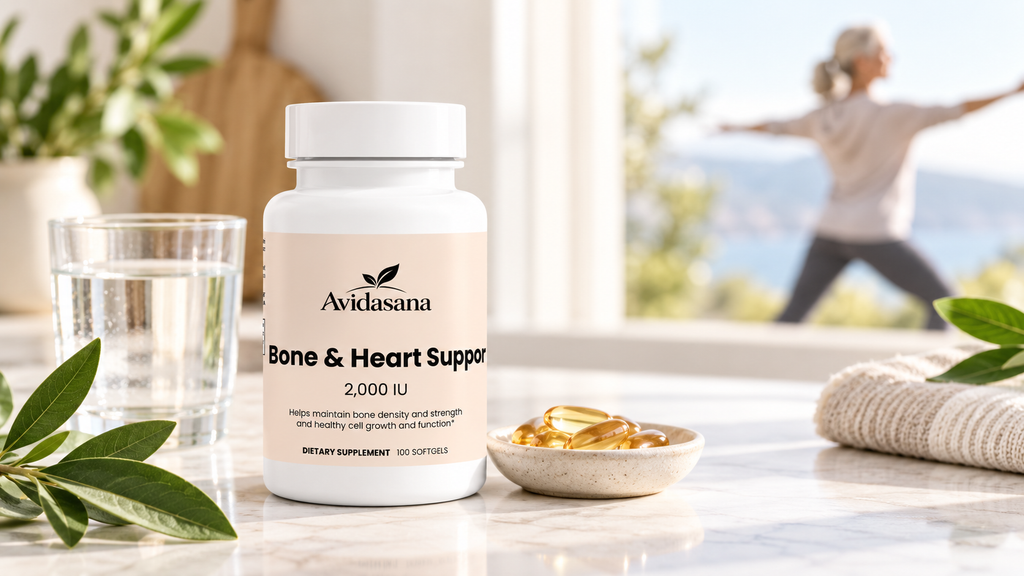
That is the thinking behind AvidaSana Bone & Heart Support, a dietary supplement combining nutrients commonly associated with bone health and normal calcium metabolism.
But before talking about supplements, it is worth understanding what these nutrients actually do—and just as importantly, what they don’t do.
Your Bones Are Living Tissue
We sometimes imagine the skeleton as the body’s permanent framework, like the beams holding up a house.
Bones are much more dynamic than that.
Bone tissue is continually being broken down and rebuilt throughout life. During youth, we generally build bone faster than we lose it. Later in life, that balance can begin shifting.
According to the National Institutes of Health Office of Dietary Supplements, bones gradually lose calcium after about age 30, with bone loss accelerating during middle age. Both men and women can eventually develop weaker bones, although osteoporosis is especially common among women.
That makes nutrition increasingly important as we age.
And one mineral sits at the center of the conversation:
calcium.
Calcium Does More Than Build Bones
Most of the body’s calcium is stored in the bones and teeth.
That is probably why we associate calcium almost entirely with bone health.
But calcium also participates in normal muscle contraction, nerve signaling and other essential biological processes.
Your body carefully regulates the calcium circulating in your blood because it needs calcium for these functions.
If dietary calcium intake is inadequate over time, the body can draw calcium from its reservoir—your bones.
That’s one reason getting adequate calcium throughout life matters.
Food should generally be the starting point.
Dairy foods such as milk and yogurt are familiar calcium sources, but calcium can also be found in fortified plant beverages, certain fish, tofu and other foods.
The American Heart Association notes that dairy foods and fortified dairy alternatives can contribute calcium and vitamin D as part of a healthy eating pattern.
Dietary supplements can sometimes help fill nutritional gaps, but more is not automatically better.
Vitamin D Helps Your Body Use Calcium
You could consume calcium all day long, but your body still needs help absorbing it.
Enter vitamin D.
Vitamin D plays a major role in calcium absorption and normal bone mineralization.
Without enough vitamin D, your body cannot absorb calcium as efficiently.
That is why calcium and vitamin D so often appear together in bone-health discussions.
Vitamin D can come from several sources.
Our skin can produce vitamin D after sunlight exposure. Certain foods contain it naturally, while others—such as milk and some plant-based alternatives—are fortified with it.
However, vitamin D status can vary based on age, sun exposure, skin pigmentation, diet and other factors.
The important point is not that everyone automatically needs a high-dose vitamin D supplement.
It is that vitamin D is an essential part of normal calcium metabolism and bone health.
The NIH identifies calcium, vitamin D and magnesium among the important nutrients involved in building and maintaining strong bones.
Where Does Vitamin K Fit In?
Vitamin K doesn’t receive nearly as much attention as vitamin D.
But it also plays important roles in the body.
Vitamin K is involved in normal blood clotting and is also associated with proteins involved in bone metabolism.
The NIH notes that severe vitamin K deficiency can affect blood clotting and that vitamin K is needed for healthy bones. Researchers continue to study whether vitamin K supplementation can improve bone health or reduce fracture risk, but the evidence is not yet conclusive.
Some supplements use a form called vitamin K2, often as menaquinone-7 or MK-7.
The idea behind combining vitamin D3 and vitamin K2 is that these nutrients participate in different parts of normal calcium metabolism.
That is biologically interesting.
But this is also an area where advertising can sometimes get ahead of science.
Does Vitamin K2 “Keep Calcium Out of Your Arteries”?
You may have seen supplements advertised with dramatic claims that vitamin K2 sends calcium directly into bones while keeping it out of arteries.
The biology is more complicated than that.
Vitamin K-dependent proteins are involved in calcium-related processes, and researchers continue studying whether vitamin K status influences cardiovascular health.
But that does not mean a K2 supplement has been proven to prevent arterial calcification, heart attacks or cardiovascular disease.
In fact, a randomized clinical trial discussed by the American Heart Association found that vitamin K2 plus vitamin D did not slow progression of calcium buildup in the aortic valves of older men in that study.
That’s an important distinction.
A supplement may support normal nutritional function without being a treatment for cardiovascular disease.
At AvidaSana, we think consumers deserve to understand that difference.
What About Vitamin D and Heart Health?
Vitamin D is unquestionably important for bone health.
Its role as a cardiovascular supplement is less certain.
Observational studies have found associations between low vitamin D levels and higher rates of cardiovascular problems.
But association is not the same thing as cause and effect.
Large clinical trials have not demonstrated that taking vitamin D supplements prevents heart attacks or strokes in otherwise healthy adults.
The American Heart Association has specifically cautioned that while vitamin D is important for health, clinical evidence has not shown supplementation to reduce heart attack or stroke risk.
So why call a nutritional product Bone & Heart Support?
Because calcium, vitamin D and vitamin K all participate in normal physiological processes relevant to bones, muscles, blood vessels and circulation.
But “support” is the key word.
A dietary supplement should complement healthy habits—not replace them.
Heart Health Starts With What You Do Every Day
No capsule can compensate for an unhealthy lifestyle.
The American Heart Association’s updated 2026 dietary guidance continues emphasizing basic habits that have stood the test of time:
Eat plenty of fruits and vegetables.
Choose mostly whole grains.
Choose healthy protein sources.
Favor unsaturated fats over saturated fats.
Limit highly processed foods.
Reduce excess sodium.
Limit added sugars.
Maintain a healthy body weight.
And stay physically active.
It may not sound as exciting as the newest miracle nutrient advertised online.
But that’s because good health is often boring.
It is built through thousands of ordinary decisions repeated over decades.
Healthy Bones Need Exercise Too
Nutrition is only half of the bone-health equation.
Bones respond to physical activity.
Weight-bearing activities such as walking, dancing and resistance exercise give the skeleton mechanical stimulation.
Strength training also helps preserve muscle.
And muscle matters tremendously as we age because stronger legs and better balance may reduce the likelihood of falls.
Think about bone health as a three-part strategy:
Nutrition + Strength + Balance.
A supplement can contribute nutrients.
It cannot do your walking for you.
Unfortunately.
We checked.
Why Supplements May Still Have a Place
Even with a good diet, some people may not consistently obtain adequate amounts of certain nutrients.
That can happen because of dietary preferences, limited food choices, reduced appetite, digestive problems, limited sunlight exposure or other circumstances.
This is where a thoughtfully selected supplement may be useful.
Bone & Heart Support from AvidaSana is designed as a convenient way to add bone-supporting nutrients to an overall wellness routine.
The idea isn’t to replace food.
It isn’t to replace exercise.
And it certainly isn’t to replace medical care.
It is to provide another nutritional tool.
You can explore other healthy-aging products at AvidaSana.com as part of building a wellness routine that fits your individual needs.
One Important Warning About Vitamin K
There is one issue that deserves special attention.
Vitamin K can interact with certain anticoagulant medications—particularly warfarin.
Warfarin works partly by interfering with vitamin K-dependent clotting processes. Significant changes in vitamin K intake can therefore affect how the medication works.
The American Heart Association advises people taking anticoagulants such as warfarin to pay attention to vitamin K intake and medication interactions.
If you take warfarin or another medication affecting blood clotting, talk with your physician or pharmacist before starting a supplement containing vitamin K.
That isn’t fine print.
It’s important.
More Isn’t Always Better
There is a natural tendency with supplements to think:
“If some is good, more must be better.”
The human body doesn’t work that way.
Calcium and vitamin D are essential nutrients, but excessive intake can cause problems.
The NIH notes that research on calcium supplements and cardiovascular risk has produced mixed findings, which is another reason supplementation should be individualized rather than treated as automatically beneficial for everyone.
If you already take vitamin D, calcium, a multivitamin or another bone-health supplement, check the labels before stacking products together.
You may already be consuming more than you realize.
For people with medical conditions or those taking prescription medications, discussing supplements with a healthcare professional is especially sensible.
Healthy Aging Is About Maintaining What Lets You Live
Why care about bones?
Because strong bones help you remain mobile.
Why care about muscles?
Because strong muscles help you remain independent.
Why care about your cardiovascular system?
Because everything you want to do tomorrow depends on it working today.
Healthy aging isn’t simply about adding more birthdays.
It is about protecting your ability to participate in life.
Taking the walk.
Getting on the bicycle.
Dancing.
Traveling.
Playing with grandchildren.
Gardening.
Climbing the stairs.
Getting out of a chair without thinking about it.
Those ordinary abilities become extraordinarily valuable with age.
The Bottom Line
Calcium, vitamin D and vitamin K all play legitimate roles in human nutrition.
Calcium is fundamental to bone structure.
Vitamin D helps the body absorb and use calcium.
Vitamin K participates in normal blood clotting and proteins involved in bone health.
But supplements shouldn’t be presented as magic.
They do not replace nutritious food, exercise, healthy body weight, appropriate medical care or medications prescribed by your physician.
Think of supplementation as one piece of a much larger healthy-aging puzzle.
If your diet or lifestyle leaves nutritional gaps, a carefully chosen supplement may help complement the work you’re already doing.
You can learn more about AvidaSana Bone & Heart Support and explore additional products at AvidaSana.com.
Because healthy aging isn’t about finding one miracle pill.
It’s about giving yourself the best possible foundation for the years still ahead.
AvidaSana — Vida means life. Sana means health. A healthy life.
Dietary supplements are not intended to diagnose, treat, cure, or prevent disease. Consult your healthcare professional before beginning a new supplement, particularly if you take prescription medications, have a medical condition, or take an anticoagulant such as warfarin.
